
Winning 2027 Starts Now
Why the New Pentagon Leadership Must Prioritize Building a Software-Defined Force in 2025


The United States’ Department of Defense (DoD) frequently cites 2027 as the year it must be ready to deter or defeat an invasion of Taiwan by the People’s Republic of China (PRC). This timeline is based on statements made by Chinese officials, including Chinese President Xi Jinping, directing the People’s Liberation Army (PLA) to accelerate its modernization. This leaves the DoD little time – less than two years – to modernize America’s forces.
Yet neither the DoD, nor its industrial base are well positioned to address the China challenge if they maintain the status quo of producing expensive exquisite platforms on five year capital cycles. Thus, now is the time to re-examine the DoD’s priorities, as a new presidential administration and its new Pentagon leadership have a unique opportunity to reorient the DoD to what is actually achievable between now and 2027: leveraging commercial technology to field a software defined force focused on the most pressing operational challenges in the Indo-Pacific.
As one of us (Artem) recently stated publicly, “new warships [or other platforms with decades-long procurement cycles] are not coming between now and 2027, but software is.” Digital cycle times (the period from inception to capability delivery) are significantly shorter than those required for hardware. Thus, software is delivered and upgraded at the speed of operational relevance, rather than being slowed by bureaucratic inertia. The service life for a Navy ship is 35 years. In contrast, OpenAI upgraded from GPT 3.5 to GPT 4 in less than a year, and NVIDIA releases new, more powerful GPUs1 every two years. Even more complex hardware systems like Tesla regularly release new and improved car models and software updates. In today’s era of rapid technological change, a software-defined force is not a nice to have – it is a necessity.
In order to build this force, the Pentagon’s new leadership should (1) prioritize acquiring a short list of mature commercial, software-first technologies, developed by companies funded by private capital, that solve the most pressing operational challenges associated with a cross-strait invasion of Taiwan; (2) reform acquisitions processes to rapidly prototype and scale the aforementioned technologies faster than the Chinese, while simultaneously divesting from legacy capabilities; and (3) align leadership and resources behind both.
China “Gets It”
The PLA’s 2027 modernization is already underway. According to the DoD’s Military and Security Developments Involving the People’s Republic of China 2024 report, the PLA seeks “[to] improve its proficiencies across all warfare domains…[and field] next-generation combat capabilities based on its vision of future conflict, which it calls ‘intelligentized warfare’ (智能化战争), defined by the expanded use of artificial intelligence (AI), quantum computing, big data, and other advanced technologies.” Combined, these technologies enable the PLA to accelerate its kill chain, the process by which a military force locates, targets, and engages an opposing force. Digital technologies shorten the time it takes to complete the kill chain.2 In other words, the PLA is pursuing a software-defined force.
China’s strategy of Military-Civil Fusion (军民融合) – which aligns the PRC’s defense industrial base to its civilian technology and industrial base – enables the PLA to rapidly develop and acquire advanced dual use technologies, such as those listed above for intelligentized warfare. China is turning the United States’ Cold War playbook on its head. Instead of out-innovating the PLA using best-of-breed technologies developed in a competitive market, the DoD continues to pursue a Soviet-style budgeting process, outlining five year future defense plans (FYDP) alongside “defense primes” whose incentives are not always aligned with producing the highest quality products in an efficient manner. .
China’s strategy of investing in a software defined force appears to be paying off. Deputy Assistant Secretary of the Air Force for Acquisition Maj. Gen. Cameron Holt stated that the PLA is fielding new equipment “five to six times faster” than the United States, and “in purchasing power parity, they spend about one dollar to our 20 dollars to get the same capability.” While there is some debate on Chinese acquisition cycle times vis-a-vis the United States’, it is true that the DoD’s overall buying power has decreased, as has its ability to stop a PLA invasion of Taiwan with its current program of record force.
The urgency for change has never been greater. To maintain deterrence and counter China's rapid military advancements, the Pentagon’s new leadership must act decisively to build a software-defined force before 2027.
The China Problem through INDOPACOM’s Eyes
Admiral Samuel Paparo is the four star officer at the head of the U.S. Indo-Pacific Command. He is charged with maintaining a free and open Indo-Pacific, and by extension, deterring a Chinese invasion of Taiwan. Paparo characterized China’s plans as an attempt “to offer the world a short, sharp war so that it is a fait accompli before the world can get their act together.” He explained that China routinely “rehearses” the forced reunification of Taiwan with the mainland using short notice military coercion events in which hundreds of PLA aircraft, warships, and gray zone assets such as its maritime militia and Coast Guard, encircle the island, much like they would in the event of an invasion.
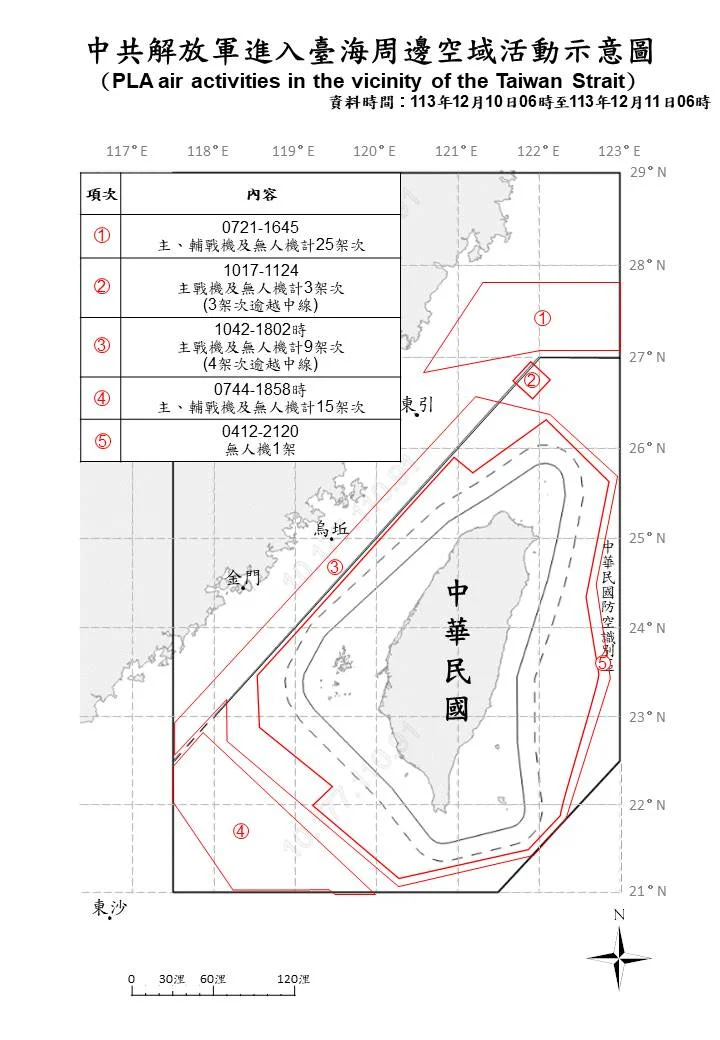
Source: Taiwan Ministry of Defense
This potential invasion poses several operational problems to INDOPACOM. First, while the United States maintains an advantage in capabilities such as cyber, space, and counter-space,“our [ammunition] magazines run low… and our maintenance backlog grows each month…,” said Paparo. Over the past several decades, the People’s Liberation Army (PLA) has spent considerable resources developing technology specifically designed to counter US forces in the Indo-Pacific. This strategy is commonly referred to as China’s Anti-Access / Aerial Denial (A2AD) strategy and includes a series of sensors; antiship, antiaircraft, and ground defenses; and long-range fires designed to prevent the United States from entering into a close fight in the Indo-Pacific region. When describing the threat posed by the PLA, Paparo explained that “[the PRC has] got 2,100 fighters… three aircraft carriers… a battle force of 200 destroyers.” Moreover, China has invested in long range anti-ship ballistic missiles (ASBMs), which Paparo acknowledges would pose a threat to U.S. aircraft carrier strike groups in the event of conflict. This is a far cry from the China of the early 2000s when “the PRC Navy mustered about 37 vessels,” said Paparo.
Thus, if the PLA crosses the Taiwan Strait, the U.S. military will be forced to close the kill chain against thousands of warships, warplanes, and landing craft, while also defending its own forces. But the U.S. has neither the expensive missiles3 in enough quantity4 to defend Taiwan, nor the warships, submarines, and aircraft to deliver those missiles due to readiness challenges.
The unique physical geography of the Indo-Pacific region changes the balance of military power. Paparo explained, “The Pacific is a contested space over about 8000 miles of ocean by 8000 miles of ocean…” where the United States’ nearest base to Taiwan is Okinawa – over 400 miles away. Meanwhile, the PLA only has to transit 90 miles to reach its objectives. But the PLA will not sit idly by as the U.S. attempts to relieve Taiwan: “When we run war games [for the Pacific Theater], the red team goes for the combat logistics force, every single time,” said Paparo.
Most recently, he published an article in the U.S. Naval Institute’s Proceedings magazine citing the Navy’s Navigation Plan 2024 as a framework for thinking through the operational challenges of:
Contested Logistics - How might the U.S. military reach Taiwan and sustain its forces over thousands of miles if the PLA attempts to disrupt its logistics?
Long Range Fires - How will the U.S. military engage thousands of PLA targets with limited munitions?
Terminal Defense - How will the U.S. military defeat long range attacks by advanced Chinese munitions.
Readiness - How can the United States increase its overall preparedness for a conflict with China; i.e. having forces available and fit for purpose.
INDOPACOM’s recommended solution to these operational challenges is to reorient the U.S. military towards the procurement of innovative commercial capabilities, delivered to the warfighter through new rapid acquisitions processes. Paparo states that “we’ve got to move beyond boutique programs [of record]” and towards “procurement at the speed of combat.” Yet the Pentagon “treats software updates with the same rigor as an aircraft carrier.” All of this means increasing reliance on “proven commercial technologies” while removing “bureaucratic obstacles within our system that impede progress… [and] damage our readiness.”
Paparo wants technologies that will help the U.S. military “see, understand, decide, and act faster,” underscoring the need to “find ways to combine AI tools and human decision making that deliver a decision advantage.” Other digital technologies of interest include electronic warfare systems, which Paparo acknowledges have been effective in Ukraine. Though he has also been clear that the United States must not “overlearn” the lessons coming out of recent conflicts, especially in the realm of unmanned systems; traditional capabilities still matter. In Paparo’s words, “the information age will not replace the industrial age, it will accelerate it.” Thus, the ideal future U.S. military is one which combines traditional platforms with digital capabilities such as AI and autonomous systems. “Everybody is stuck in this paradigm of ‘either or’,” but both are required to deter or defeat the PLA.
Unfortunately, today, the DoD remains overly focused on traditional platforms at the expense of digital solutions, as outlined in the DoD’s budget. AI accounts for just 0.2% of the FY24 budget, while Joint All Domain Command and Control (JADC2)5 represented a mere 0.16%. And while it is true that investments in digital technologies cannot replace traditional military platforms (Paparo stated bluntly “an app is not going to feed troops in the field”), the balance remains far too skewed towards traditional platforms, many of which will not be delivered in time for a 2027 fight.6 Software can act as a force multiplier when built on top of existing exquisite systems, enabling more precise and automated operations, freeing up warfighters’ attention to focus on the tasks that matter most.
A software defined force would not only be ready in that timeline because of the inherent speed of development but also be one that plays to America’s strengths as the world’s premier digital economy. The United States has the best software engineers, the most valuable intellectual property (semiconductor intellectual property core), and a technology sector whose market cap rivals China’s gross-domestic product ($21.1T vs $18.2T).7
Consequently, the Pentagon’s new leadership should prioritize developing digital technologies that augment the program of record force in resolving the operational challenges outlined above. In particular, we recommend that they take a digital-first approach to tackle the four operational challenges outlined above by focusing on the following technologies:
Logistics and supply chain software
Precision mass
Electronic warfare
Back office automation
While some of this work is already underway, more can be done, and more direct involvement by Pentagon leadership is essential to ensure a reorientation towards a software-defined force is successful.
Logistics and Supply Chain Software
The DoD spends $150B annually on logistics and runs one of the most complicated logistics and supply chain operations in the world – coordinating equipment (including some of the world’s most dangerous and expensive equipment) and resources for millions of people across thousands of global bases and facilities.
Experts believe the US military is unprepared to deter or fight a war with China in the Western Pacific, in large part because of the challenges of contested logistics in the region. A potential future conflict with China in the Western Pacific would be tremendously logistically challenging due to the vast distances and dispersed island chains that stretch supply lines thin across open waters and complicate efforts to move critical resources around the region efficiently.8
Further, the US may struggle to adequately manage its supply chains to manufacture and procure necessary equipment to fight a conflict with China. Many critical military systems face supply chain vulnerabilities that could be disrupted in the event of a conflict, particularly due to sole-source risk or foreign dependencies. For example, the Javelin weapons system relies on the Aerojet Rocketdyne’s advanced solid-propellant rocket motor, which does not currently have a second source. Bottlenecks like this create strategic risks, as adversaries may target such single-source suppliers in a future conflict – if Aerojet Rocketdyne’s facilities were compromised, the DoD would be unable to procure additional Javelin systems.
Foreign dependency risks arise when supply chains rely on international suppliers, potentially exposing the military to geopolitical and logistical vulnerabilities. A number of critical military systems rely on components or materials from China. A Govini report highlights that many US military systems rely on microelectronics from China, and another report reveals, “China is the single or sole supplier for a number of specialty chemicals used in munitions and missiles. In many cases, there is no other source or drop-in replacement material and even in cases where that option exists, the time and cost to test and qualify the new material can be prohibitive – especially for larger systems (hundreds of millions of dollars each).”9

Source: “Numbers Matter Defense Acquisition, U.S. Production Capacity, And Deterring China,” Govini
Current DoD logistics and supply chain management is remarkably manual, and the software that does exist is siloed, legacy, and sorely lacking. Humans manually track assets on whiteboards, Excel, and Powerpoint, place orders via phone, email, and WhatsApp, forecast demand, and draft supply plans. According to the Army Logistics University, “most current DOD logistics support systems operate within individual service silos of excellence. These systems are encumbered by service-specific proprietary operating systems and processes, with the majority providing no data analysis capability, and often hinder rather than facilitate the formulation of critical decisions. Logisticians lose valuable hours devoted to sifting through data lakes, trying to transform data into usable and relevant information to arm decision makers with actionable knowledge and analytics.”
Today, the DoD has six major Enterprise Resource Planning (ERP) systems – one for each service (Coast Guard, Army, Navy, Air Force, and Marines) and one managed by the Defense Logistics Agency (DLA) – and more than 1000 other tools it uses for other logistics-related tasks like demand forecasting. However, most of these tools are not interoperable with other tools and lack data analytics functionality, leading to many wasted hours and limited usefulness.
The new administration must prioritize modernizing these tools, building for interoperability, usability, and efficiency. While adopting modern logistics software is not a silver bullet to solving the DoD’s logistics and supply chain management challenges, it is an important step to improve DoD’s readiness to manage contested logistics in a future conflict. Better logistics and supply chain management software exists: commercial companies from Amazon to Costco to Nike, and many others, make extensive use of digital technologies like demand forecasting, robotic processing automation, predictive maintenance, supply chain visibility and tracking, logistics optimization, and much more to run efficient and secure logistics and supply chain operations. Additionally, as I’ve written about previously, recent advancements in generative AI could lead to step change improvements in the state of logistics software, as AI agents and reasoning models can help with tasks like route planning, forecasting, optimization, and even simple data integration and data entry.


There are already several ongoing DoD initiatives to improve digital logistics tools. For instance, the Air Force is developing a system known as BLADE (Basing & Logistics Analytics Data Environment) to bring together information from more than 300 Air Force and broader Defense Department data sources to enable data analytics for logistics. BLADE is built on top of a Pentagon analytics platform called Advana. Similarly, the Chief Digital and AI Office (CDAO) is experimenting with using generative AI for logistics. In March 2024, CDAO’s 9th GIDE exercise experimented with using GenAI to draft supply plans.
A number of startups and commercial technology companies have emerged in recent years to help large organizations like the DoD and Fortune 500 enterprise manage their logistics and supply chains using modern software including Rune, Altana, Palantir, o9, C3.AI, and others.
Precision Mass
Michael Horowitz writes, “For millennia, commanders considered mass – that is, having numerically superior forces and more materiel than the other side – critical to victory in battle. An army stood a greater chance of vanquishing its foes if it could deploy a greater number of troops, whether armed with spears, bows, and rifles or sitting in tanks…The last 50 years, however, saw a turn away from mass toward precision,10 a trend accelerated by the end of the Cold War. Militaries such as that of the United States discovered greater efficiency and effectiveness in the use of expensive advanced weapons that could accurately strike targets all over the world. Leaders chose to scale down the size of their forces and focus instead on honing their technological advantages.”
Recent conflicts have shown the effectiveness of mass combined with precision: “precision mass”. Perhaps most notably, both Russia and Ukraine have made extensive use of first person view (FPV) drones11 for both kinetic and ISR purposes. FPV drones are an excellent example of precision mass, as they are cheap and small enough to be developed and fielded at scale (mass), as well as precise systems that are able to narrowly target specific entities (precision). Militaries have also extensively used precision mass during recent conflicts in the Middle East – Israel, Hamas, and the Houthis have all deployed small drones over the past year.
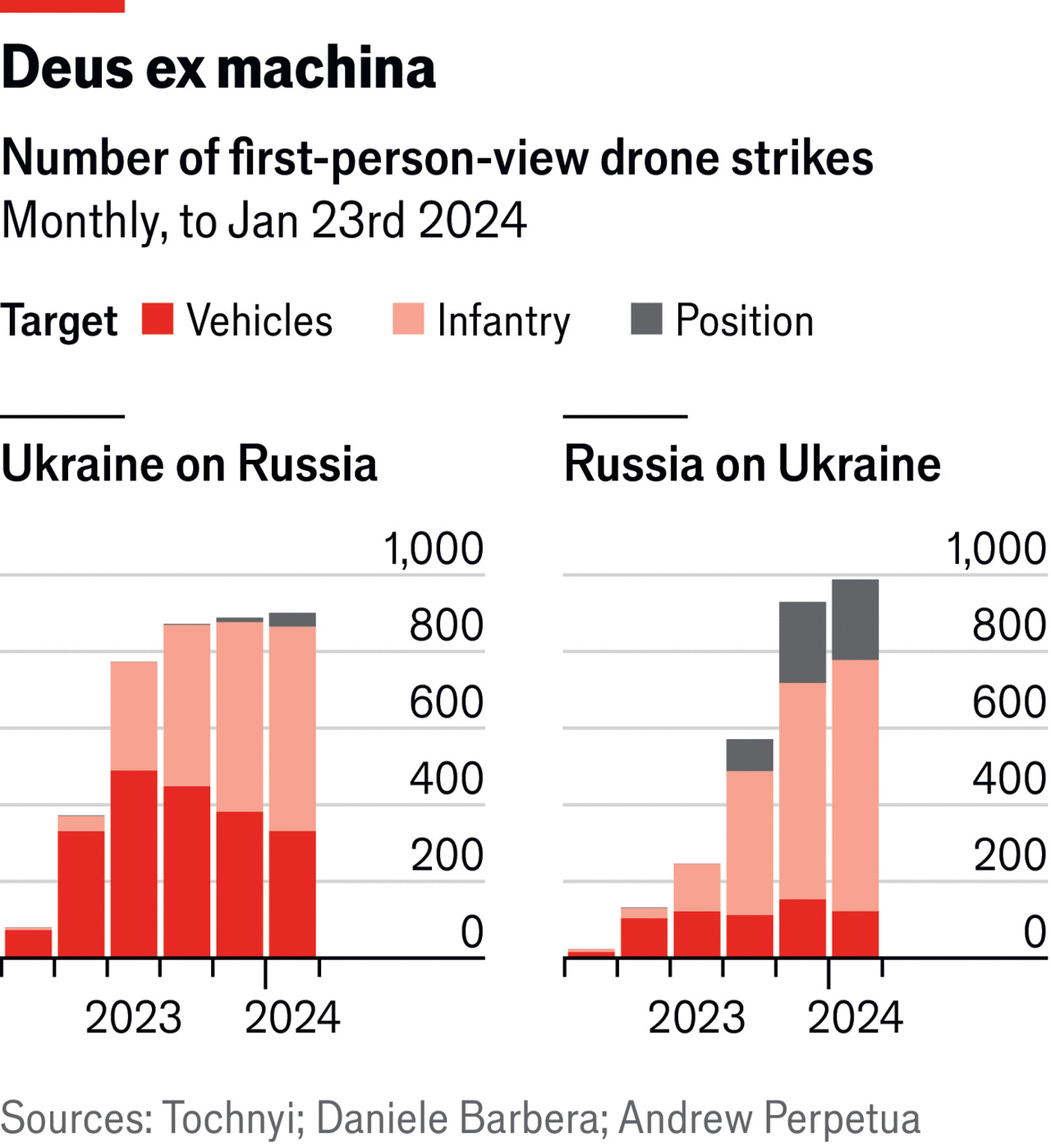
Source: “How cheap drones are transforming warfare in Ukraine,” The Economist
Precision mass technologies are software defined systems rather than exquisite hardware systems. FPV drones like those used in Ukraine are relatively cheap (a few hundred to a few thousand dollars) and typically built using off the shelf components. They are powerful because the software they run allows them to fly unmanned (and often autonomously) to carry out tasks, creating a force multiplier effect.
While the US has made significant strides in developing precision mass (ex: US FPV drone startup Neros recently announced that it won a contract to deploy thousands of American-made, NDAA compliant drones to Ukraine, an environment where many US drone startups have failed), it still remains behind China in developing affordable, autonomous precision mass. Chinese company DJI dominates the FPV market, with ~70% global drone market share,12 and even non-Chinese FPV drone makers rely on Chinese components (particularly for components like batteries). The exact tactics for fielding precision mass in a conflict in the Indo-Pacific will be different from those used in recent land wars. As a CNAS report states, “The geography of the Indo-Pacific significantly disadvantages the United States, which needs drones with long range and considerable endurance that will inevitably cost more than the drones used in Ukraine, Nagorno-Karabakh, and Libya.”
Precision mass is affecting more than just the aerial domain – startups and traditional defense primes alike are developing software and AI-defined unmanned systems capable of being deployed at scale to navigate on the ground and in the ocean to carry out missions with minimal human oversight. A number of startups have started in recent years to build US-made precision mass systems across all three domains including Shield AI, Skydio, Neros, Saronic, SeaSats, Overland AI, Havoc AI, Swarmbotics, and more.
In order to accelerate the pace of development and deployment of precision mass, the US must also invest in autonomy-enabling technologies like improved testing and simulation tooling, robotics software libraries, hardware design tools, edge optimization technology, manufacturing automation, and more. Most of the development tools hardware and robotics engineers use today are decades old and were not designed to build software-defined systems. As a result, engineering teams have had to build custom tools in house that serve the unique development needs of building systems capable of delivering precision mass. Luckily, a new wave of entrepreneurs are tackling this challenge; many startups have emerged to provide the infrastructure backbone for autonomous systems development including Resim, Nominal, Foxglove, Code Metal, Sift, Pictorus, Arena AI, and many more.


Electronic Warfare
Today’s warfighters are more vulnerable to electronic disruption than ever before, as the modern battlefield is more reliant than ever on digital systems like drones, software defined radios, ATAK devices, satellites, and more. As such, modern warfighters are highly susceptible to electronic warfare (EW) attacks in which enemies are able to use electronic jammers to disrupt communication systems, disable navigation tools, identify soldiers’ positions, and much more.

Source: “Electronic Warfare,” Saab RDS
There is no easy way for soldiers to manage electronic warfare (EW) on the battlefield. The systems warfighters use today to detect and disrupt EW attacks are often expensive and difficult to use, requiring months or years of training.
It is essential that the new administration prioritize fielding improved EW management software. Advancements in commercial off the shelf sensor technology, machine learning, and edge processing all have the potential to greatly improve how soldiers manage EW. Instead of deploying multi-million dollar exquisite sensors, the DoD should acquire smaller, cheaper, off the shelf software defined radios (SDRs) that are able to sense and record radiofrequency (RF) data on the battlefield.
Additionally, rather than requiring human operators to manually analyze raw RF data, the DoD should field systems equipped with machine learning (ML) algorithms that run on edge in order to analyze RF data and provide soldiers with insights into the RF environment. Today, as startups like Distributed Spectrum and CX2 have shown, it is possible to develop ML algorithms that run on edge that provide soldiers with information about the RF environment – for example, ML algorithms can inform soldiers if their GPS or communications are being jammed, and it can tell them where enemy forces are based on their RF emissions.
In addition to acquiring software defined solutions that provide greater visibility into the RF and EW environment, the DoD should prioritize deploying systems that leverage EW over kinetic solutions for defensive applications. For example, consider a surface warship’s missile defense system: there are two approaches to defend a surface warship against an enemy missile attack – “hard kill” and “soft kill.”13 “Hard kill” capabilities are kinetic capabilities (like missiles) that use an explosive effect to defeat an incoming projectile. In contrast, “soft kill” capabilities use electronic warfare (and sometimes other techniques) to divert an incoming missile from its target without actually physically intercepting the weapon by emitting electromagnetic waves to jam enemy targeting radars and missile guidance systems. Software defined soft kill systems tend to be much cheaper and more repeatable than hard kill systems. Shooting missiles at enemy projectiles (missiles, drones, etc) is much more expensive than emitting electromagnetic waves, and a target can easily run out of missiles, but will not run out of electromagnetic jamming capabilities.
Back Office Automation
The DoD (and US government as a whole) is notorious for its copious paperwork, rigorous compliance processes, and use of legacy software. According to a US Chamber of Commerce report, manual, paper-based processes cost the US government an estimated $38.7B each year due to information capture and processing bottlenecks. While many of these processes exist for good reasons, like ensuring software products meet cybersecurity standards and high value contracts are awarded fairly, they are also often unnecessarily time consuming and expensive, significantly slowing down the pace of innovation and progress. Many innovative technology companies purposefully avoid working with the DoD due to the expensive and time consuming nature of DoD compliance processes. Many of these processes could easily be automated with commercial technology that exists today, making the DoD much more efficient.
One basic automation technology DoD should explore is “robotics processing automation” (RPA), which companies in the commercial sector have used for years. RPA uses “software robots” to automate repetitive, rules-based digital workflows, and is particularly effective for high volume, low complexity standardized processes. Users can hard code specific RPA workflows where the software RPA “robot” is able to click, type, and interact with an application the same way a human does. The technology is particularly powerful for organizations (like the DoD) that rely on legacy software systems that lack robust APIs2 and other modern integration tooling. In 2021, the DoD created an RPA working group and is actively exploring and deploying RPA use cases in their legacy tech stack.

Source: Raising logistics performance to new levels through digital transformation
RPA can be used to automate all kinds of manual processes that plague the DoD, like data entry tasks. For example, DLA is actively exploring how it can use RPA to automate logistics invoicing.14 Previously, this task would have required humans to manually input invoicing data into multiple systems of record, however, RPA is able to automate this tedious task, saving hours of human labor. Similarly, NASA is using RPA to automate parts of managing grants, the USAF is using RPA to improve its audit processes, and the Army is using RPA to automate parts of the retirement payment, student loan repayment, and insurance collection processes. All of these processes were previously paperwork intensive and highly manual, but can be made much more efficient with simple RPA.
In addition to RPA, advancements in generative AI (GenAI) can also dramatically accelerate back office automation. For example, consider the acquisitions process, an extremely manual and paperwork heavy process. GenAI could be used to automate a swath of manual tasks conducted by acquisitions officers. For instance, the Army is exploring the use of GenAI to assist acquisitions officers with tasks such as drafting and generating RFIs, RFPs, scope of work, defining requirements, down-selecting bidders and more. Similarly, GenAI could assist foreign disclosure officers (FDOs) streamline the foreign military sales (FMS) process. A GenAI model could ingest the DoD’s thousands of pages of foreign disclosure policies, use those policies to assess material for foreign discloser, flag any pieces of information that go against policy (ex: perhaps a Powerpoint presentation reveals information about nuclear-hardening techniques which cannot be disclosed with foreign militaries which a GenAI model could catch), and then generate the paperwork needed to approve information for foreign disclosure.
GenAI can also make DoD back office processes more efficient by improving the state of knowledge management. The DoD manages huge amounts of data that GenAI can help sort through and analyze. For instance, rather than combing through thousands of pages of DoD budget materials manually, DoD employees can use GenAI tools like Obviant to search and analyze DoD budgeting data using natural language.
GenAI can be used similarly across a number of other paperwork and compliance heavy DoD workflows – everything from the ATO15 process, to CUI16 marking, to healthcare administration to data entry could be sped up by GenAI, freeing up operators time to focus on tasks that truly make the US and its allies more security.
New Acquisitions Processes
The DoD will need new acquisitions processes to realize the vision of a software-defined force outlined above. Accordingly, the Pentagon’s new leadership should scale the processes employed by the Defense Innovation Unit, which identifies dual-use technologies that solve operational problems, and then rapidly prototypes, experiments with, and then scales those technologies. This is done with a combination of in-execution-year money applied to Other Transaction Authorities (rapid contracting mechanism outside of the Federal Acquisition Regulations), as well as outcome-driven experimentation, vice process driven (requirements, cost, schedule performance) acquisitions. Crucially, funding for these technologies should come from structured divestment from legacy systems.
This holistic divest-to-invest approach should be centrally managed outside of the military services to avoid parochialism or programmatic mismanagement. Thus, successfully fielding these technologies inside of the 2027 timeline will require not only financial investments, but personal energy investment from the Pentagon’s new political and military leadership. These individuals will need to identify the personnel under their charge who can lead these innovation activities, while simultaneously identifying and removing bureaucratic barriers in their way.
To ensure the United States remains capable of deterring aggression in the Indo-Pacific, the Pentagon’s new leadership must take decisive action to build a software-defined force by 2027. The window for meaningful change is closing, and relying on traditional procurement cycles will not meet the urgency of the moment. By embracing commercial technology, streamlining acquisition processes, and prioritizing digital capabilities, the DoD can field solutions that enhance operational effectiveness at the speed of relevance. Without a doubt, startups backed by private capital will play a role in developing and deploying the cutting edge technology the DoD needs to remain competitive, and the DoD should find sustainable ways to improve its approach to working with startups. The PLA is already modernizing at an unprecedented pace, and the United States cannot afford to fall behind. The challenge is clear, and so is the opportunity – leadership must act now to ensure the U.S. military is prepared for the threats ahead. The future of deterrence – and the ability to maintain a free and open Indo-Pacific – depends on it.
As always, please reach out if you or anyone you know is building at the intersection of national security and commercial technologies. And please let me know your thoughts! I know this is a quickly changing space as the administration rolls out its new initiatives, and I welcome any and all feedback. What else should the new Pentagon leadership prioritize to ensure the US is ready to deter China in 2027?
GPU = Graphics Processing Unit
For more on how digital technologies will affect the future of warfare and kill chains, we recommend reading The Kill Chain: Defending America in the Future of High-Tech Warfare by Christian Brose.
In nearly two dozen iterations of a Center for Strategic and International Studies (CSIS) war game that examined a U.S.-China war in the Taiwan Strait, the United States typically expended more than 5,000 long range missiles in three weeks of conflict (4,000 joint air-to-surface standoff missiles, 450 long range anti-ship missiles, 400 hundred harpoon missiles, and 400 tomahawk missiles.
U.S. conventional munitions production will not keep pace with the above expenditures. According to the DoD’s Fiscal Year 2024 (FY24) budget, the joint force procured 125 Standard Missile-6s (the Navy’s long range surface to air missile), but the Navy fired over 220 missiles in defense of Red Sea shipping since October 2023.
JADC2 is a DoD-wide initiative designed to improve the integration and interoperability of U.S. military forces across all domains and services. The goal is to provide a unified, cohesive approach to military operations, enabling faster and more efficient decision-making and response times. For more, see the DoD’s Summary of the Joint All-Domain Command and Control Strategy.
The United States began preparing for WWII - an industrial war which it was uniquely suited to fight - in 1936, which was five years prior to Imperial Japan’s surprise attack on Pearl Harbor. Today, the United States does not possess the industrial capacity to conduct a five year buildup; nor does it have five years until 2027. For more on U.S. industrial preparation before and during WWII, we recommend Freedom’s Forge by Arthur Herman.
GDP, or gross domestic product, (the total value of goods and services produced in a country) and market capitalization (the total value of all publicly traded stocks in a country) are not a one-for-one comparison. However, GDP-market cap ratios, also known as “the Buffet indicator” is useful in gauging overall stock market valuation (ratio closer to 1 is better). Nonetheless, we use this comparison just to show the shear size of the United States’ technology sector since $21T is hard to comprehend on its own.
For those interested in a deep dive on the challenges of contested logistics in a conflict in the Western Pacific region, I highly recommend this essay by Zachary Hughes on the subject.
For an excellent overview of US Supply Chain Vulnerabilities, particularly as they relate to China and Russia, see the “US Supply Chain Vulnerabilities” report released by the US-China Economic Security Review Commission.
For more on the “revolution in military affairs” that led the US to prioritize developing and fielding precision munitions, see The Long Search for a Surgical Strike: Precision Munitions and the Revolution in Military Affairs by David Mets.
FPV drones are small, cheap, remote-operated copter-powered UAVs.
One Ukrainian military official suggested that Ukraine was buying as much as 60% of all DJI Mavic quadcopters.
Also see this article diving into “hard kill” vs. “soft kill” systems for drone defense.
ATO = Authority to Operate
CUI = Controlled Unclassified Information
Note: The opinions and views expressed in this article are solely my own and do not reflect the views, policies, or position of my employer or any other organization or individual with which I am affiliated.
 |
|
The problem is that even in software, the DoD applies its traditional siloed processes to acquire redundant tools and waste precious budget. The structure of the department (into multiple services - Army, Navy, etc.) as well as OSD itself contributes to this tribalism - our own DoD fights with itself rather than work on collaborative, interoperable software tools to fight China. In the 21st century, having military services starts to make less and less sense. Each service does something in every domain and mission area - land, air, sea, space, cyber, and so on.
This is an incredibly comprehensive analysis. However, you reference a concept you don’t emphasize enough: cost.
War between meet peers is a slug fest. Who can land the most hits. Who can absorb the most hits.
Cost matters. A lot. The basic unit of war remains the howitzer shell. US cost $3k. Chinese cost $1k. The differential is similar for almost every unit of warfare. Unless the US can compete on cost, it loses. I don’t see the US doing anything to fix its cost structure disadvantage.
Supply chain is also a problem. See my LinkedIn post on this. It will take a decade and cost $3tr to make the IS military independent of Chinese inputs. We can’t wage war on them because they control our military supply chain. I don’t see any effort in DC on that other than chips.
We are…fucked.