

Where do great defense tech founders come from? As a venture capitalist (VC) investing in early stage, national security startups, one of the most important (and most difficult) parts of my job is evaluating startups’ founding teams. When evaluating early stage startups, the team is the most important factor of any investment decision – technology, products, and markets can all evolve, but the founding team is much more difficult to replace.
Do defense tech founders need to have military or intelligence community experience? Do they need to have a PhD and/or an MBA? Do they need to have experience working at a VC backed startup? Or a big tech company? Or a big defense prime? Or both? Do they need to have experience working at SpaceX, Palantir, or Anduril?
Of course, every great founding team is unique, perhaps even more so in defense. Defense tech founders will need to navigate bureaucratic government procurement and security certification processes and build at the technical frontier, while moving at startup speed. They need to attract excellent talent, sell investors on their vision, lobby Congress, and deploy cutting edge technology to operators in mission-critical environments.
So, where have previous successful defense tech founding teams come from? To better understand what successful national security startups have in common, I analyzed the founding teams of the companies featured in SVDG’s 2026 NatSec 100 list,1 looking for patterns and recurring characteristics. I used Pitchbook to collect the list of founders and key executives (CEO, CTO, COO) for each company, and I used Claude to enrich each founder’s profile with the following information:
Primary professional background (e.g., engineer, researcher, academic, founder, military operator, business leader)
Highest educational degree achieved (high school, bachelor’s, master’s, PhD, MBA, etc)
Technical vs. non-technical background
Prior military service
Prior intelligence community (IC) experience
Prior aerospace, defense, or national security company experience
Previous employers (3–5 most significant)
Note that Claude may have made some mistakes, as I did not carefully check every piece of information it collected, but this analysis should show broad directional trends.
What kinds of professional roles did defense tech founders have?
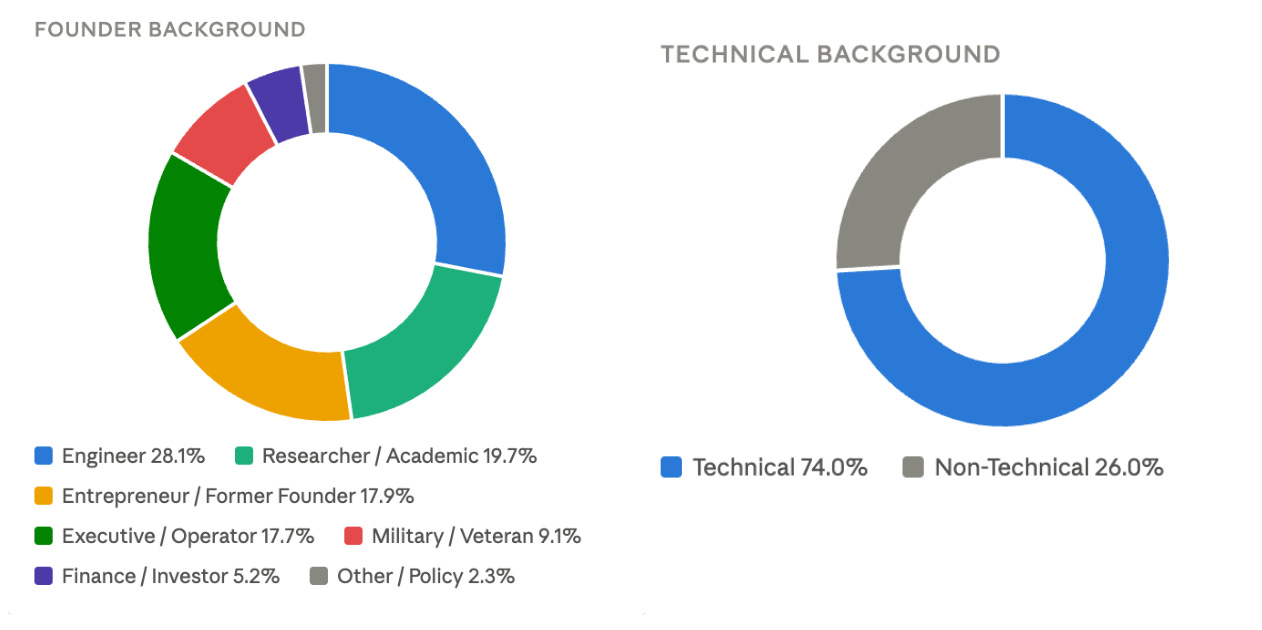
Perhaps unsurprisingly, almost half of all national security startup founders were previously engineers, researchers, or academics before starting their companies, and close to 75% have some kind of technical background.
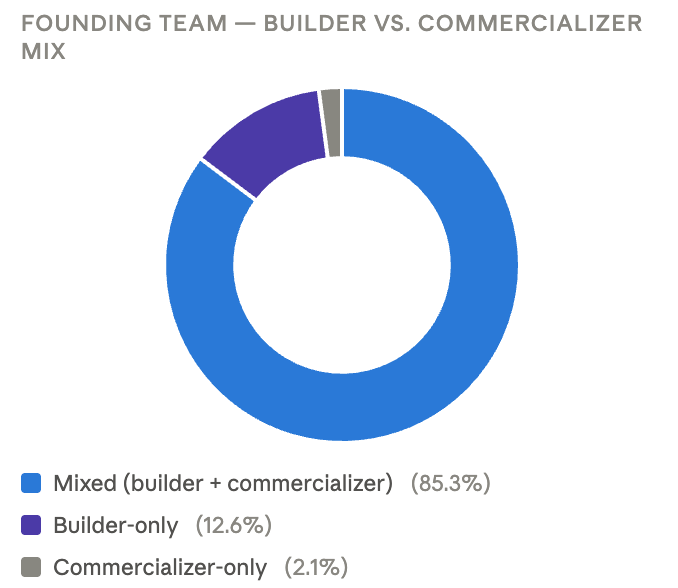
Looking at founding teams as a whole, most combine founders with complementary technical “builder” backgrounds (engineers, researchers, and academics) and non-technical “commercializer” backgrounds (founders, executives, and operators). Successful national security startups need both exceptional technical leadership to build differentiated products and strong commercial leadership capable of navigating complex government and defense procurement processes.
Do defense tech founders need prior defense experience?
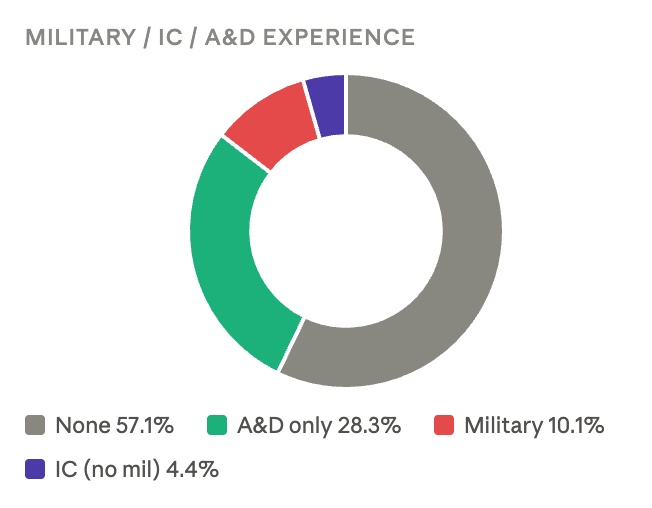
Notably, the majority of national security founders have no past military, IC, or aerospace and defense (A&D) private company experience. Fewer than one-third of founders have prior experience at a private A&D company (e.g., SpaceX, Anduril, Lockheed Martin), and less than 15% have actual military or IC experience (of course, many with military and IC experience do not publicly advertise their past, so it is possible that they are under-represented in the publicly available data as a result).
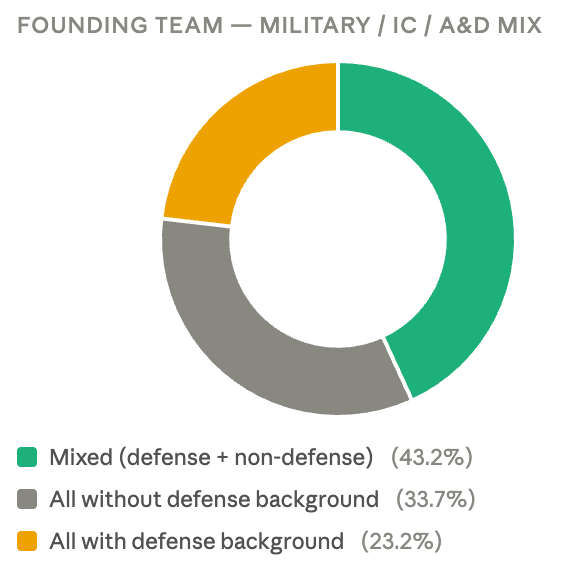
However, looking at founding teams as a whole, most companies have at least one founder with prior defense experience, whether through military service, the IC, or the A&D private industry. For example, Shield AI’s founding team combined CEO Brandon Tseng’s military experience as a Navy SEAL together with the robotics expertise of CTO Nathan Michael, a CMu robotics professor with no military experience. Similarly, Anduril’s founding team brought together Palmer Lucky’s technical vision with Trae Stephen’s government and finance experience, as well as Matt Grimm and Brian Schimpf’s experience developing technology for government customers at Palantir.
Only about one-third have founding teams with no prior defense experience. Given the complexity and idiosyncrasies of the national security market, that is still a surprisingly large share. It suggests that while deep domain expertise is valuable, it is not a prerequisite for building a successful defense technology company. For instance, led by MIT dropout Alexandr Wang, Scale AI’s founding team had no prior government experience, yet the company has since won hundreds of millions of dollars in military contracts. Meanwhile, Applied Intuition, founded by venture capitalist Qasar Younnis and Google product manager Peter Ludwig, has won more than $100M in military contracts.
Which organizations produce defense tech founders?
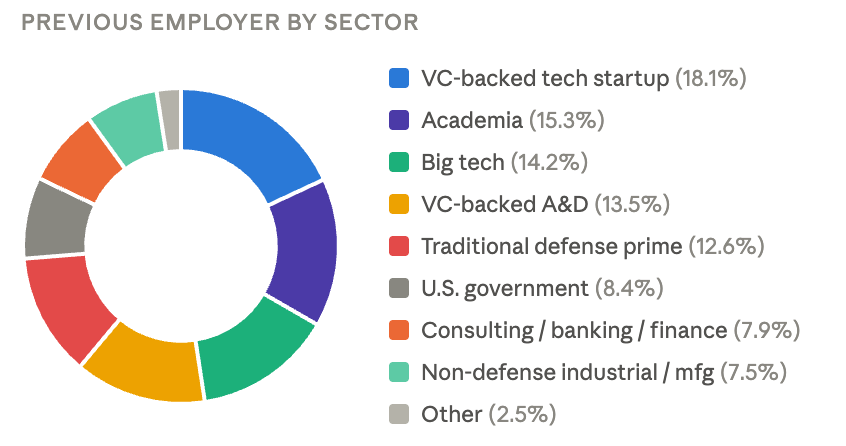
Nearly half of all prior employers are from the broader technology ecosystem (including venture-backed startups, academia, and big tech companies), while just 34.5% come from defense-focused organizations, such as traditional defense contractors, the U.S. government, or venture-backed national security companies.
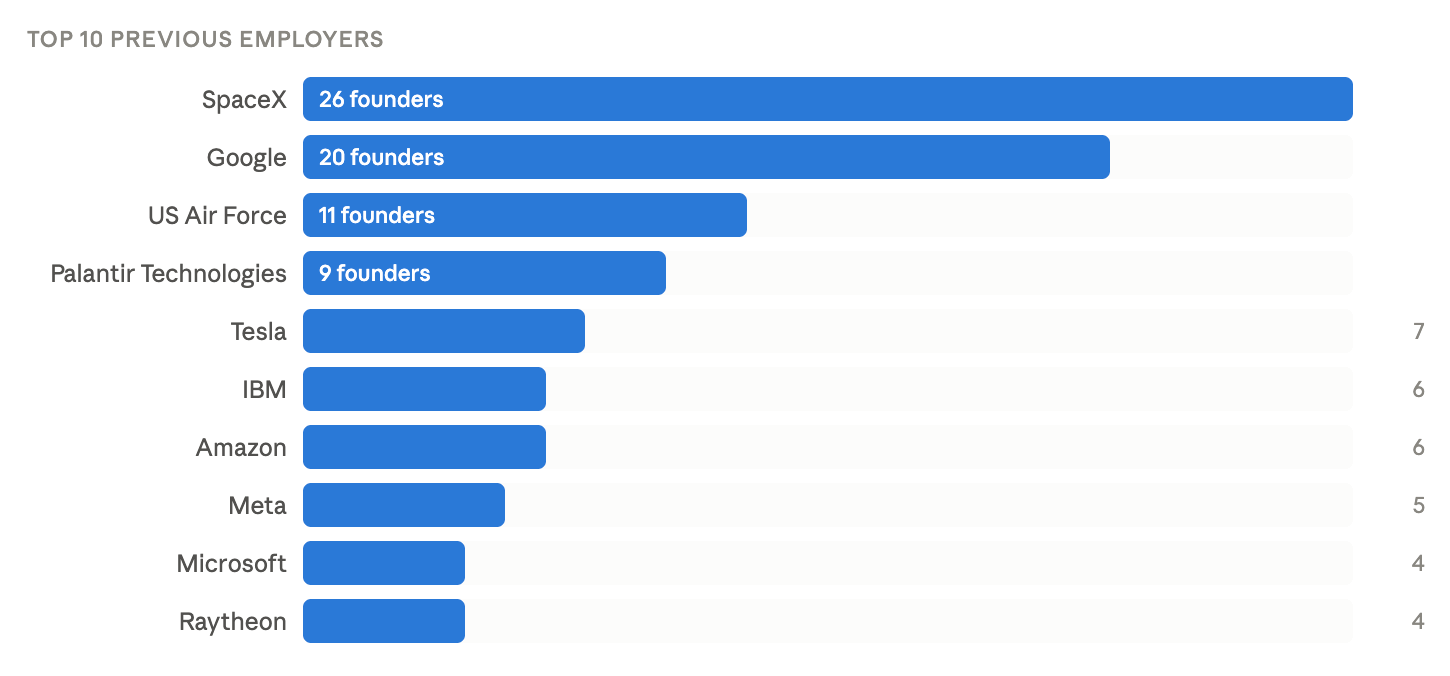
The top previous employers skew toward the broader technology ecosystem rather than the traditional defense industrial base. SpaceX and Palantir stand out as major sources of national security startup talent, producing the founders of companies like Impulse Space (SpaceX), Anduril (Palantir), Cape (Palantir), Hermeus (SpaceX), and K2 Space (SpaceX). Large technology companies like Google, IBM, Amazon, Meta, and Microsoft are also heavily represented, producing the founders of companies like Applied Intuition (Google), OpenAI (Google), Chainguard (Google), Code Metal (Microsoft), Dataminr (IBM), and Re:Build (Amazon). Tesla’s presence also suggests that founders with experience in advanced manufacturing, autonomy, and hard-tech scaling are increasingly moving into national security markets, producing several founders of OpenAI, Epirus, and JetZero.
The U.S. Air Force (USAF) in particular produces many more defense tech founders than the other military services, likely due to its history of partnering with innovative startups through organizations like AFWERX, programs like STRATFI / TACFI, and its active use of SBIR contracts for cutting edge technology.
Interestingly, traditional defense primes appear far less frequently: Raytheon is the only legacy defense contractor in the top 10, having produced founders of both Epirus and Castellion.
Where educational backgrounds do defense tech founders have?
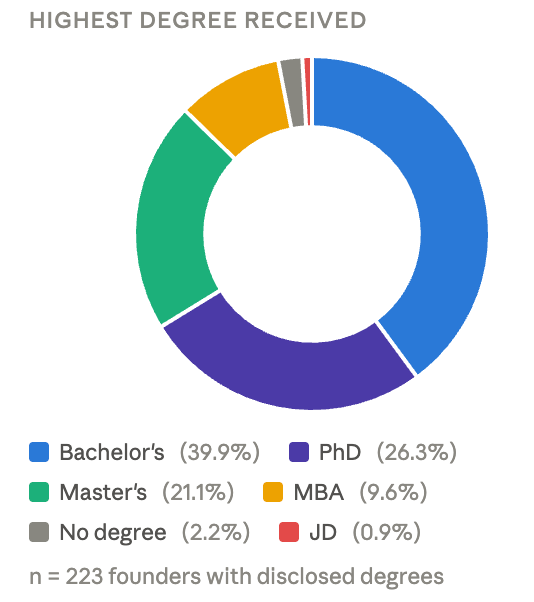
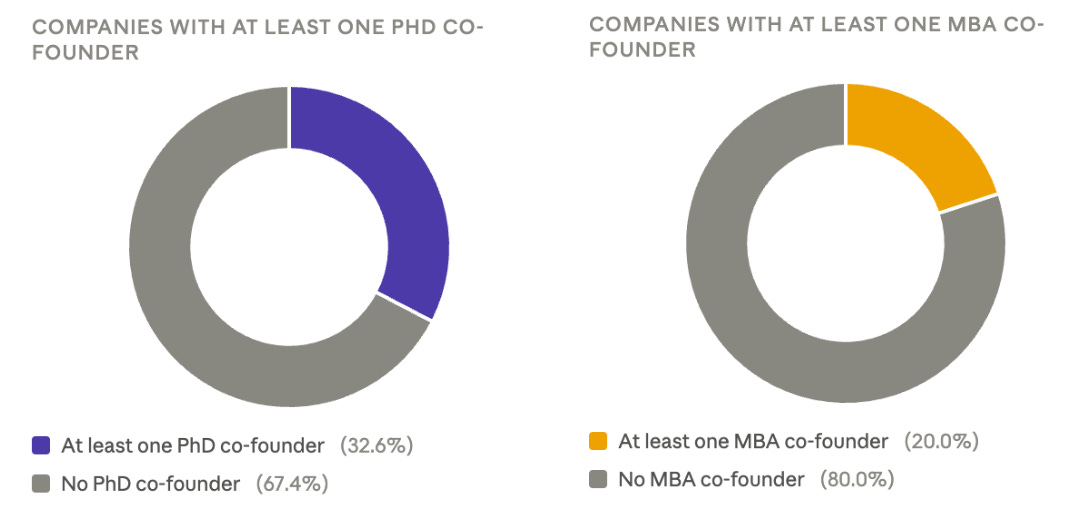
More than one-quarter of founders in the dataset hold a PhD (and nearly one-third of companies have at least one PhD co-founder), compared with roughly 2% of the U.S. population, underscoring the deep technical expertise that underpins many successful national security startups like Skydio, Shield AI, Databricks, and Starfish Space which are commercializing frontier research for defense applications.2
However, two-thirds of companies do not have any PhD co-founders, showing that not all national security startups require exquisite, research-level technical expertise. Rather than commercializing academic research, many national security startups focus on applying existing technologies to solve defense problems. For example, Neros was founded by two champion FPV drone racers without college degrees and is adapting mature, decades-old technology to build FPV drones for the U.S. military. Similarly, Apex Space is applying modern manufacturing techniques long proven in commercial industries like automotive to efficiently produce modular satellite buses.
By contrast, fewer than 10% of founders hold an MBA, and only about one-fifth of companies have an MBA co-founder. The data suggests that deep technical expertise is far more common among successful national security founders than formal business training.
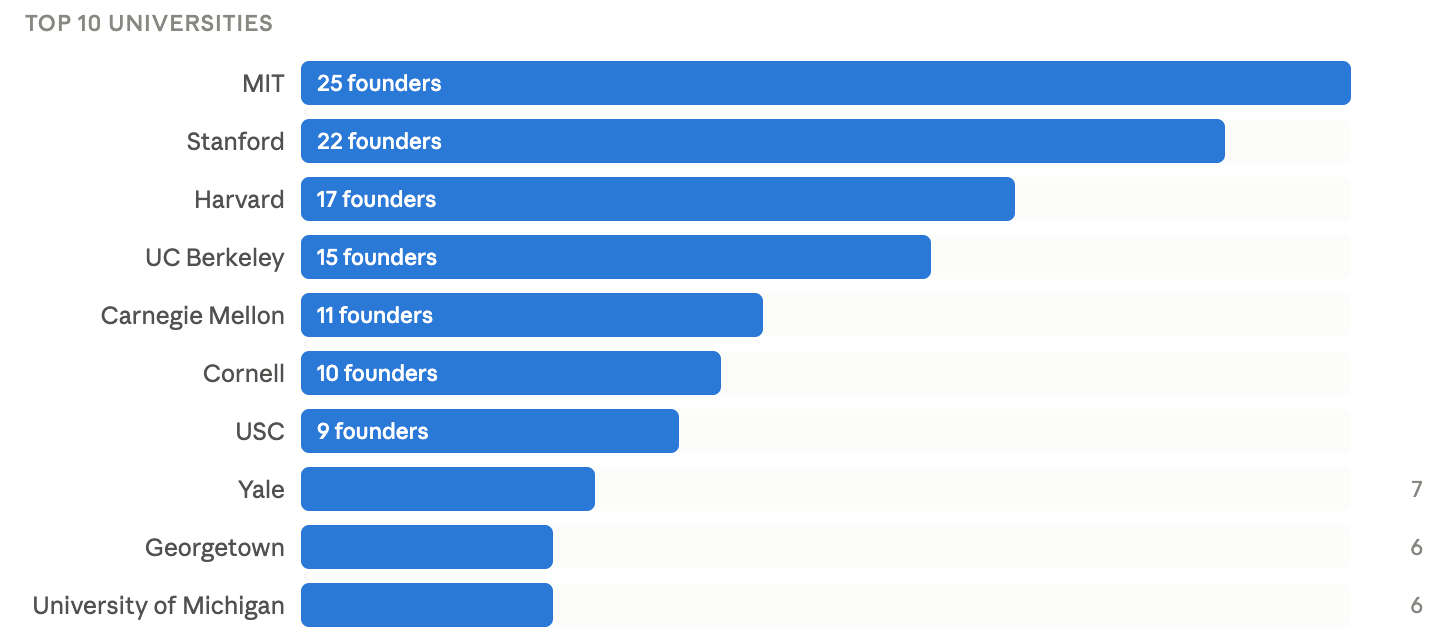
Similar to the broader startup ecosystem, founders from Stanford, Harvard, MIT, and UC Berkeley dominate the national security startup landscape. One notable difference, however, is that MIT produces more founders than any other university in the dataset, likely reflecting its strengths in engineering and applied research, as well as its longstanding ties to the national security community through MIT Lincoln Laboratory. Carnegie Mellon and Georgetown are also more heavily represented than in the broader startup landscape, likely due to their respective strengths in robotics, artificial intelligence, and foreign policy. Similarly, USC appears more frequently, reflecting its close proximity to Southern California’s aerospace and defense ecosystem.
Conclusion
Overall, there is no one “right” background for a defense tech founding team. Startups can be successful with and without military experience, with and without teams of academic researchers. The most successful national security startups are typically built by founding teams that combine technical, military, and business expertise.
Perhaps the most important takeaway is that great defense founders increasingly come from outside the traditional defense industrial base. The best founders tend to bring world-class technical talent from universities, venture-backed startups, and leading technology companies, then combine it with just enough defense expertise to navigate the unique demands of the national security market. As software, AI, robotics, autonomy, and advanced manufacturing continue to reshape warfare, that blend of frontier technical capability and mission understanding is likely to become more important than ever.
I’m more excited than ever to find and partner with the best founding teams building the technology needed for the U.S. and its democratic allies to remain competitive on the geopolitical stage. As always, please reach out if you or anyone you know is building at the intersection of technology and national security. And please let me know what you think – this data and analysis certainly is not perfect, and I’m very open to any thoughts on how to improve or refine this kind of analysis in the future.
SVDG’s 2026 NatSec 100 list is certainly not a complete or perfect list of all national security focused companies worth analyzing, but I figured it was good enough to show overall trends for founding teams of companies that have managed to raise significant capital and land large government contracts. Note that I ran a similar analysis on all companies listed in Pitchbook as “Aerospace & Defense” or “Space Technology” that were founded since 2015 and have raised at least $20M. The founding team trends were largely similar, except that SVDG’s list has more academic / PhD / researcher co-founders vs. Pitchbook’s list. This is likely because SVDG’s list includes more dual use research focused software and AI companies like Databricks and OpenAI whose founders are researchers. Unlike SVDG’s list, Pitchbook’s list is almost exclusively A&D and space hardware companies.
It’s important to note that Claude was not able to find educational data for all founders (data was missing for ~160 founders), as Claude cannot easily access LinkedIn. So, founders with higher level degrees may be over-represented in this labeled data set, as they may be more likely to include their degrees in bios available to Claude.
We actually ran a similar analysis last year on TBB with European defence tech founders. Solo founders are rare and usually it’s a team of founders. And within this team, we found a recurring pattern: founders bring a triad of skills. Some bring technical knowledge/skills while others bring this military/defence experience through operations and procurement knowledge. For having talked with VC investors, this triad is kind of essential to have a successful defence tech company (Helsing is a great example).
really intriguing data and useful