

You’ve heard of ChatGPT wrappers…but what about robotics foundation model (RFM) wrappers? In 2026, in the wake of several impressive new model releases, it seems like everyone is building RFM wrapper companies on top of models like Physical Intelligence (Pi)’s π0 and π0.5, NVIDIA’s GR00T N1.7, and Generalist’s GEN-1.5. Many of these companies will no doubt have a direct impact on national security, as they improve sectors like manufacturing, scientific discovery, critical infrastructure construction and maintenance, logistics, and more.

As the name implies, robotics foundation models are foundation models specifically designed to control robots.1 They take in sensor data (video, audio, etc), natural language instructions, robotic position data, and (optionally) task demonstration data as inputs and output direct robotic motor controls. Like large language models (LLMs), these models are designed to generalize to many different, potentially unseen, scenarios and embodiments, with minimal demonstration or instruction data required. Ideally, the same RFM could be used to control a robot arm in a factory, a quadruped robot on the battlefield, and a humanoid robot in a household, in all kinds of weather, terrain, and seasons.
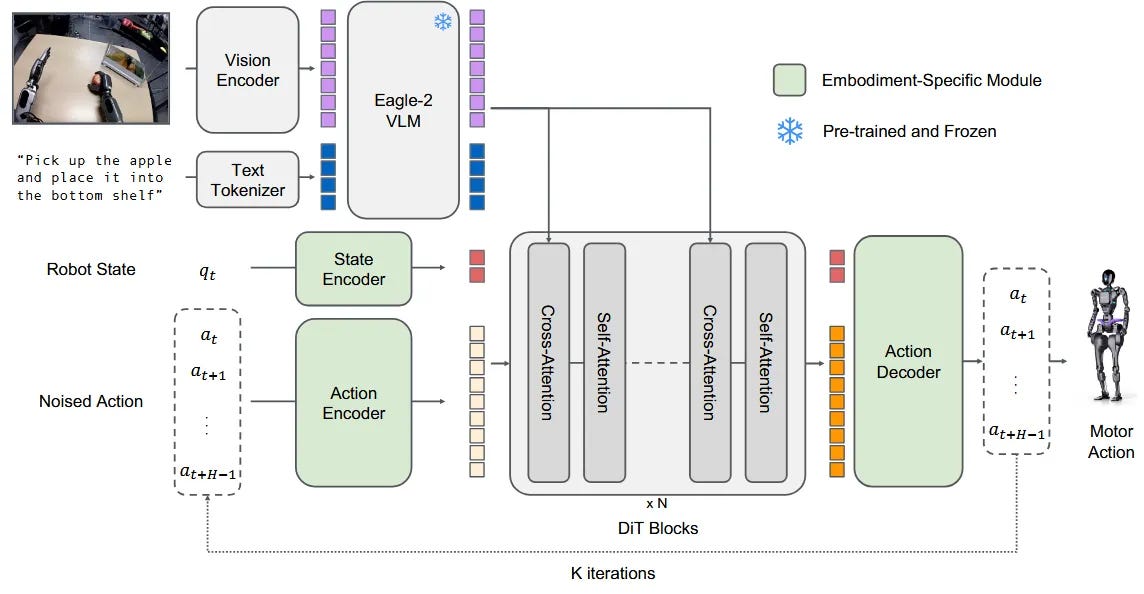
Source: NVIDIA, “GR00T N1: An Open Foundation Model for Generalist Humanoid Robots”
Over the last year, companies like Pi and Skild AI have released impressive demos of RFMs capable of folding laundry, cleaning dishes, and even cooking. Rather than manually programming each robotic control task, in these demos, users simply give the robot an open ended task in natural language (ex: “cook potatoes in an air fryer”), and the learned model determines the actions the robot needs to take to complete that task. Performance improves even further if a user provides the model with a demonstration of the task or natural language step by step instructions (ex: open the air fryer, pick up the potato, put the potato in the air fryer, close the air fryer).
These models are trained on large, diverse, multimodal real world and synthetic data sets, including teleoperated robotics data, egocentric human data, YouTube videos, physics simulation data, and more, across a range of embodiments, tasks, and environments. The need for large, diverse data sets to train RFMs has spurred an entire industry of companies collecting and labeling this data for robotics labs. The hope is that the scaling laws observed in language and coding models will extend to robotics, with ever larger models trained on increasingly diverse datasets and refined through reinforcement learning in simulation environments developing emergent capabilities that generalize across tasks and environments. This hope appears to be coming true. Recent advances in in-context learning2 from Skild AI and Generalist suggest that, like language models, as pre-training datasets and hours scale, RFMs are proving capable of conducting tasks outside of pre-training distribution with just a few seconds of demonstration sensor data, the same way language models can answer questions outside of pre-training distribution with just a few natural language sentences of context provided by the user.
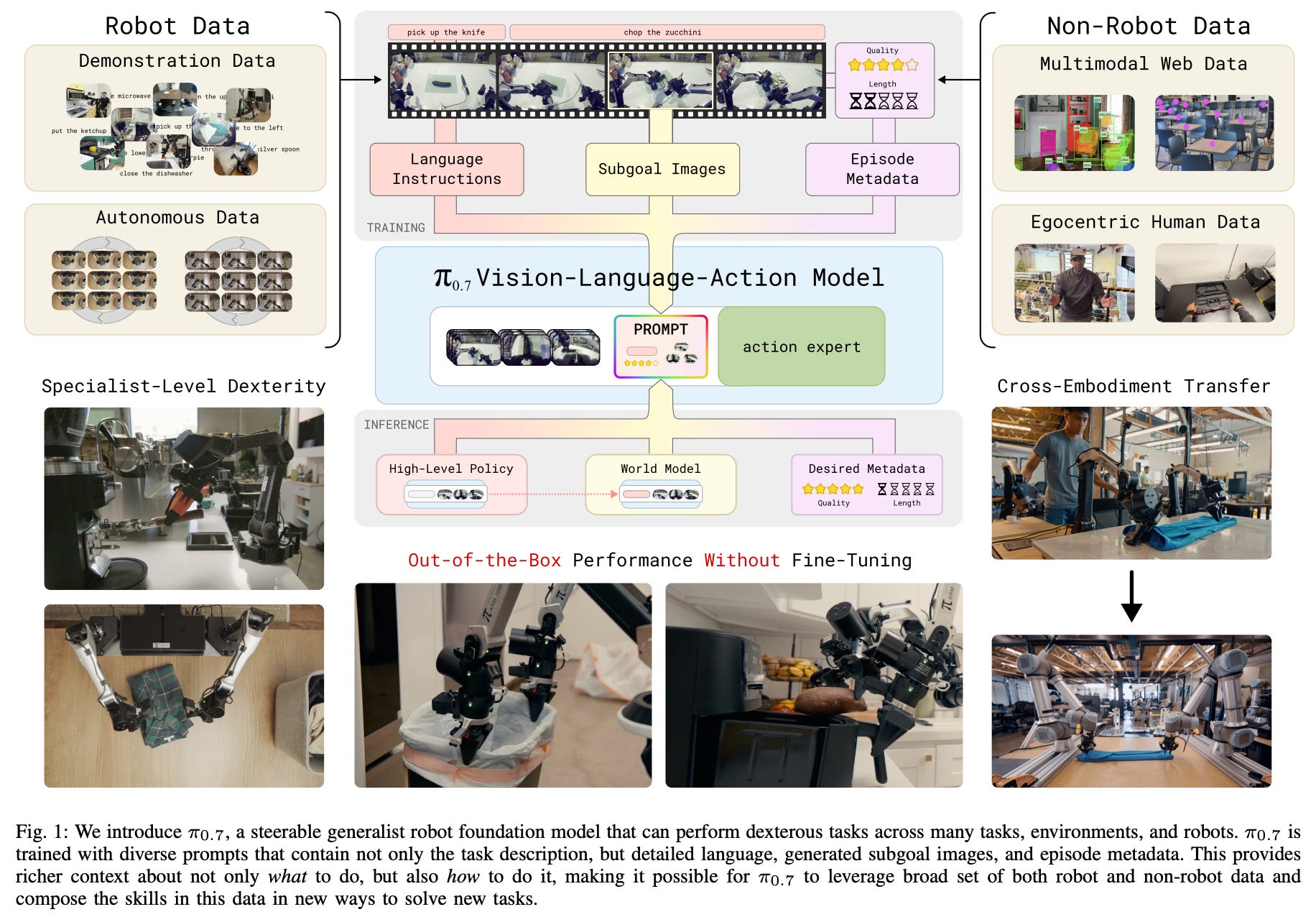
If they can be made to work reliably, RFMs will make it meaningfully easier to deploy robotics in the real world, as they will reduce the need for labor-intensive, manual robotics programming and teleoperation and allow a single model to generalize across many different tasks, rather than relying on brittle, hand-engineered algorithms that break when conditions shift even slightly from what they were designed for.
Today, most robots are “dumb”: they are either programmed to perform predefined tasks in controlled environments or operated remotely, with machine learning confined to discrete functions such as perception. For example, the vast majority of drones used in Ukraine and the Middle East are remote controlled, with limited autonomy for tasks like position hold, terminal guidance, or waypoint navigation. Where true autonomy appears on the battlefield, it is usually born of necessity: adversary systems move too fast for human decision-making, and electronic warfare denies the communications and navigation that human control depends on.
Similarly, most industrial robots are hard-coded for narrowly defined tasks, with only basic computer vision, and break when faced with conditions they were not explicitly programmed to handle, such as changes in lighting, color, or object size. Much of the cost of deployment therefore lies not in the hardware but in programming robots to conduct specific tasks. Setting up an industrial robot for an assembly operation can take months of engineering work and cost more than the robot itself, and even minor product changes can require extensive manual reprogramming. As a result, robotic automation has largely been limited to highly controlled, predictable environments, such as low-mix high-volume factories, where they can perform narrowly defined, repetitive tasks with minimal variation at a scale that can justify the high upfront integration costs. Autonomous driving is the main exception, with companies like Waymo and Tesla relying on machine learning across the full autonomy stack, from perception through prediction and planning, to operate on uncontrolled public roads.3
RFMs aim to eliminate much of this manual programming, enabling robots to execute complex tasks from simple natural language instructions. Rather than manually programming each step, a human could simply tell a robot to “assemble this drone,” and the RFM would determine how to complete the task.
However, today, for most use cases, RFMs do not yet work out of the box. Current RFMs feel like they are at a GPT-2 level of performance: it is amazing what the models are able to do, and the demos are cool, but the models still frequently make mistakes, move slowly, and aren’t yet capable of delivering a whole lot of value. It seems we’re still a few years away from a true ChatGPT breakout moment in robotics where these models are good enough for use in everyday life.
Still, a number of companies have emerged to build on top of this new crop of models to make them useful for specific tasks, fine tuning foundation models on domain specific data and deploying them on increasingly cheap off the shelf hardware (“RFM wrappers”). While the U.S. government is not yet a customer for these RFM-powered robots, many of these companies are applying these technologies to use cases that strengthen U.S. critical industries and the industrial base, across industries including manufacturing, scientific discovery, logistics, and critical infrastructure construction and management.
This new crop of startups differentiates itself from the large general purpose robotics labs by adapting general purpose models to specific customer use cases. Rather than collecting large, diverse data sets like the large labs, these startups focus narrowly on data specific to their industry, robot embodiment, and target tasks, collected through a mix of in-house operations, third-party data vendors, and enterprise partnerships. These startups also differentiate themselves from large labs by choosing industry-specific hardware embodiments for the robots themselves and by building custom integrations with industry-specific software and hardware tools to ensure their robots can work with existing toolsets (ex: lab robotics startup Medra has built integrations to allow their robots and software agents to operate more than 75% of the instruments scientists already use in labs).
The large RFM labs are taking different approaches to this ecosystem. Some, like Pi, actively encourage startups to build on their models: Pi recently launched an API that lets companies fine-tune and host Pi models for their own domain-specific use cases. Others, like Skild AI, keep their models proprietary and own the customer relationship themselves, adapting the technology for domains such as manufacturing, food preparation, and logistics.
Manufacturing
By far the most common RFM use case relevant to national security I’ve come across is manufacturing – particularly, assembly. While factories have employed robots for years, adoption has largely been concentrated in low-mix high-volume industries such as electronics and semiconductors, automotive, plastics and chemicals, and food and beverage. These applications typically rely on expensive, highly customized robotic production lines that require significant upfront engineering and capital investment.
In contrast, robotics are seldom used for high-mix low-volume manufacturing and other tasks that require dexterous manipulation or that handle deformable materials. Due to relatively low production volumes, most aerospace & defense manufacturing is still primarily manual, as are most contract manufacturers, and manufacturers of deformable products like wire harnesses.
However, there are a host of new startups fine tuning RFMs deployed on COTS hardware for manufacturing tasks. Companies like Foundry Robotics, Matter, Nidus, Deft Robotics, Dream Machines, and Formic Robotics are fine tuning RFMs for high-mix low-volume assembly, developing robots capable of assembling everything from wire harnesses to battery packs to robotic components without requiring extensive manual re-programming for each new assembly. Thus far, most of the companies in this space have focused on assembly rather than other manufacturing processes, such as welding, grinding, or painting, likely because today’s RFMs have been trained predominantly on dexterous manipulation tasks, such as folding laundry and handling objects, which translate more naturally to assembly than to processes requiring specialized tools, precise force control, or an understanding of material properties.
Scientific Discovery
Several startups are fine tuning RFMs to automate lab work needed for scientific discovery. Like manufacturing, labs have employed robots to automate simple, repetitive work, like pipetting, for years, but have failed to automate more complex and variable tasks. Companies like Medra are building autonomous scientific research labs, leveraging RFMs to operate lab equipment and robots for customers like Genentech. There are also a handful of academic projects like LabVLA exploring how VLAs and RFMs can automate scientific labwork.
Logistics
Many startups are fine tuning RFMs to automate logistics tasks, another area critical to national security. Historically, logistics automation tasks like warehouse automation have been engineered around predictable throughput and SKU4 profiles. Fixed systems are costly to reconfigure when demand or product mix shifts, and robotic picking has often required item-specific engineering to handle new or irregular SKUs. However, companies leveraging RFMs can autonomously adapt to new SKUs without manual reprogramming and have flexibility as throughput seasonally ebbs and flows throughout a year.
Companies like Remy AI, Ultra, inLoop, Yondu, and Frontier Machines are building custom RFMs for warehouse automation tasks like picking, receiving, kitting, sorting, packing, box assembly, visual inspection, labeling, wrapping, and unpacking. Companies in China have already begun to scale deployments of RFMs for logistics – Chinese robotics company RobotEra recently deployed its VLA-controlled humanoid robots at close to a dozen logistics hubs for tasks like bar code alignment.
In the more distant future, autonomous trucking and delivery companies could leverage RFMs to improve logistics, as autonomous driving companies like Wayve, Tesla, and Waymo make progress on full end-to-end learned autonomous driving models.
Critical Infrastructure Construction and Maintenance
Several startups are fine-tuning RFMs to build and maintain critical infrastructure, strengthening systems that underpin national security. Companies like Roma are building construction-specific foundation models to power purpose-built robots for framing, pouring, and finishing on jobsites where Roma itself acts as the general contractor and developer, so that each building generates the deployment data the next one learns from. Actor is fine tuning RFMs built by Pi to operate heavy construction machinery including excavators and bull dozers.
A number of companies are focused on building construction robots for specific critical industries, including data center and energy infrastructure. Shephard Robotics, Cybernetic Physics, General Instinct, and Proprio Robotics are fine tuning RFMs specifically for data center construction and management, focusing on tasks like cable handling and inspection; equipment checks and evidence capture; cable connection and assembly; mechanical and PCB assembly; server assembly; kitting; packaging; fan insertion; switch recabling; RAM extraction; GPU cabling; disk hot-swap; and heatsink removal. In the energy space, Cosmic Robotics is also building autonomous robots focused on solar farm and data center construction leveraging RFMs and other models for tasks like robotic planning and control.
Managing Models’ Shortcomings
Despite the years of research and billions in funding, RFMs are still not fully ready for most real world deployments, and companies building in the space must find ways to manage the technology’s shortcomings. Some companies, like Cosmic Robotics, continue to rely on more classical robotics controls technologies for parts of the stack, with plans to swap out those modules when this next-generation of technology is ready. Others like inLoop employ human teleoperators who are ready to take over control of the robot if the underlying model makes a mistake, while still others have teams of humans working alongside robots, capable of completing any tasks robots cannot.
Business Models
These companies are pursuing several different business models, each with its own tradeoffs. On the one hand, some companies sell or lease robots to external customers to help those customers automate their own operations. For example, Formic is selling robots to manufacturers to build different products, but they are not manufacturing products of their own. On the other hand, many startups are vertically integrated, using the robots they build in house to operate businesses, with the hope that the robotics technology affords them a structural advantage (speed, quality, cost, etc) over competitors. For example, rather than selling robots to construction companies, Roma functions as a construction company itself, operating a team of AI agents, robots, and humans as a general contractor running the construction site. Similarly, Medra has built a scientific lab that uses robots and AI agents to conduct research, while Matter Robotics and Foundry Robotics are both operating as full stack contract manufacturers, using a mix of humans and robots to build for customers, rather than selling robots to manufacturers.
There are several benefits to this kind of vertical integration. First, companies can collect data from their own operations to fine tune and improve their foundation models. In contrast, when selling robots to a third party, many customers (particularly those in sensitive industries like A&D and medical) may be unwilling to share performance data from the robots. Second, it allows for imperfect technology. When shipping a robot to a customer, that robot needs to work — mistakes, debugging, and maintenance all impact customers’ margins and willingness to buy and use a system. In contrast, startups deploying imperfect robots in their own operations can rely on human workers to perform tasks the robots cannot yet handle, while quickly intervening to resolve edge cases and other operational challenges as they arise. Operating as a vertically integrated facility allows startups to “dogfood” their own product and perfect the technology, and can be a bridge to one day selling robotics technology to third parties when the technology is ready.
Additionally, vertically integrated operators can scale revenue more quickly, as they are selling into well-established budget lines (ex: companies have well-established budgets for contract manufacturing, but NOT for manufacturing robotics) and do not need to go through the process of selling robots to outside customers, which tends to be an extremely slow process, especially when working with large corporations,5 often requiring years of pilots, cybersecurity accreditations, and quality testing.

Further, one of the major challenges robotics companies have faced over the years is generating positive ROI for their customers. Often, the ROI calculation looks good on paper, but can fall apart when faced with a real world deployment. Consider an example: on paper, a particular manufacturing robot may be able to automate a specific part of a manufacturing process that previously required three people. Let’s say the robot costs $100K / year to operate, and the cost of human labor to complete the same task is $150K / year ($50K / person / year). At first it seems the robot can save the customer $50K / year! Perhaps it can even unlock more revenue by increasing throughput! However, when the customer actually deploys the robot, they realize there are many additional costs including the cost of:
Transporting the robot to the customer site
Integrating with existing hardware and software systems
Repairing the robot
Tending the robot (does it a require a human to hand it materials? Set it up each day? Charge it or change its batteries?)
Fine tuning for customer use cases
Customer safety and reliability testing
Cybersecurity certifications
Site preparation (floor leveling, safety cages or light curtains, power drops, network/Wi-Fi coverage, clearing fixed obstacles)
Process redesign
Insurance and liability
Operator training (how hard is it to use the robot? Do you need any specialists to manage the robot?)
Operating as a vertically integrated facility allows companies to sidestep the challenges of working with risk-averse, cost sensitive third party customers.
Of course, the downside to operating as a vertically integrated facility is the operational complexity that comes with running these facilities. Pure play robotics companies can focus all their resources on building excellent robots, whereas vertically integrated companies will also need to manage the day to day operations of running contract manufacturers, construction sites, laboratories, etc, which come with a whole host of human resources, regulatory, supply chain, and financial complexities.
Startups planning to sell robotics technology directly to customers rather than operating in a vertically integrated fashion can do so in several ways. First, they can sell integrated hardware-software systems directly to customers, with customers paying an upfront cost to outright purchase the robotics hardware (perhaps with a recurring fee to pay for software).
Second, they can employ a “robotics-as-a-service” (RaaS) model, in which the startup maintains ownership of the robot and charges the customer a recurring fee to use it. Owning the fleet lets the startup push software updates and swap in hardware improvements over time, much like a SaaS company that ships new features to existing customers. Some startups may choose to combine these two models, structuring the financing as a loan, in which the customer pays the cost of the product over time and ultimately owns the system outright after the loan is repaid.
Third, some startups may choose to sell only software, charging a recurring fee, which they can deploy and integrate onto hardware already owned by the customer. Many customers have already purchased robotics hardware for experimentation or other automation tasks, and may prefer to leverage the hardware they already own, rather than invest additional capital in more hardware.
Conclusion
While RFMs are not yet ready to control any robot embodiment across any task in any environment, they are showing real promise to automate tasks critical to national security. Fine-tuned on narrow, domain-specific data, deployed on domain-specific hardware, and paired with human fallbacks, today’s models are already good enough to start automating the high-mix, low-volume work that has long resisted automation: defense assembly lines, lab benches, warehouse floors, and construction sites.
Most potential customers, especially those whose only experience is with the previous generation of brittle, hand-programmed robots, face a blank-slate problem. They don’t know where these models can generate a return or how to integrate them into their operations. Startups that own the domain data, hardware integrations, and operational know-how are positioned to close that gap and capture value as the underlying models improve.
The stakes go beyond commercial returns. China already leads in deploying traditional industrial robots and dominates robotics hardware manufacturing. Beijing has made robotics a national priority backed by substantial capital and subsidies, and Chinese firms are already deploying RFM-controlled robots across logistics and manufacturing networks.6 Staying competitive will require the U.S. to sustain investment in frontier research, inside and outside universities. It will also require backing the companies that turn that research into deployed systems. In robotics, the advantage will go not to whoever builds the best demo, but to whoever deploys at scale first.
Note that in this piece I use the term “robotics foundation model” as a catch-all term to describe a transformer-based system that takes in sensor data and context and outputs robotic motor controls. An RFM system may include multiple models including vision language models (VLMs), vision language action models (VLAs), vision transformer models (ViT), world models, encoder / decoder models, and more.
“In-context learning” is a model’s ability to complete a new task from examples in the prompt without retraining and tends to improve as models and pre-training datasets get bigger.
Notably, while Waymo uses ML heavily for perception and prediction (that is, perceiving its environment and predicting what other objects in the environment will do), its planning and controls systems, which decide how the car itself should drive, combine learned models with explicit, rules-based models that include traffic rules, safety margins, and validation checks. Waymo also relies on detailed, pre-built HD maps of its service areas. Tesla, by contrast, has replaced most of its hand-written, rules-based planning code with end-to-end neural networks that learn driving behavior directly from fleet data.
SKU = Stock Keeping Unit. A SKU is a unique alphanumeric code that businesses assign to individual product variants to track inventory, monitor sales, and manage stock levels.
Although, as Jeff Ding points out, many of the revenue and deployment claims made by Chinese robotics companies are overhyped, propped up by government subsidies and contracts with state-owned enterprises, which are often significant shareholders themselves, artificially inflating figures that don’t reflect true free market demand for the technology.