

No two days are ever alike in venture capital (VC), and no two venture capitalists spend their time in the same way. Each successful VC has their own unique strategy to see, pick, win, and support the best early stage technology companies. VC feedback cycles are long – it can take 5-10 years to know if an early stage investment is successful. As such, I’m always trying to learn how best to spend my time to maximize my chances of seeing, picking, winning, and supporting generational technology companies building in national security.
I’m now almost exactly three years into my time on the investment team at an early stage, national security-focused VC firm, and I wanted to share the rhythm I’ve developed on how I spend my time (with the caveat that I am always learning and iterating).
Ultimately, my primary job is to 1) see, 2) pick, 3) win, and 4) support early stage technology companies building in national security that have the potential to deliver outsized returns to my firm’s limited partners (LPs). To me this means:
Seeing: Sourcing and identifying the most compelling investment opportunities before they become obvious to the broader market.
Picking: Evaluating hundreds of pitches to select the few companies with the strongest potential to become category-defining outcomes.
Winning: Earning the right to partner with top founders in competitive rounds against other leading investors.
Supporting: Helping portfolio companies accelerate growth through strategic guidance, customer access, recruiting, fundraising, and operational support.
Fundamentally, everything I spend my time on (professionally) is in service of those four goals.
I spend the bulk of my time on the following tasks:
Sourcing and founder meetings
Investment diligence
Portfolio company support
Relationship building and ecosystem engagement
Market research and thesis development
Podcast and blog writing
LP fundraising and investor relations
For those curious, here is an anonymized screenshot of my calendar from a few weeks ago, which represents a pretty typical week (although, of course, every week is a bit different):
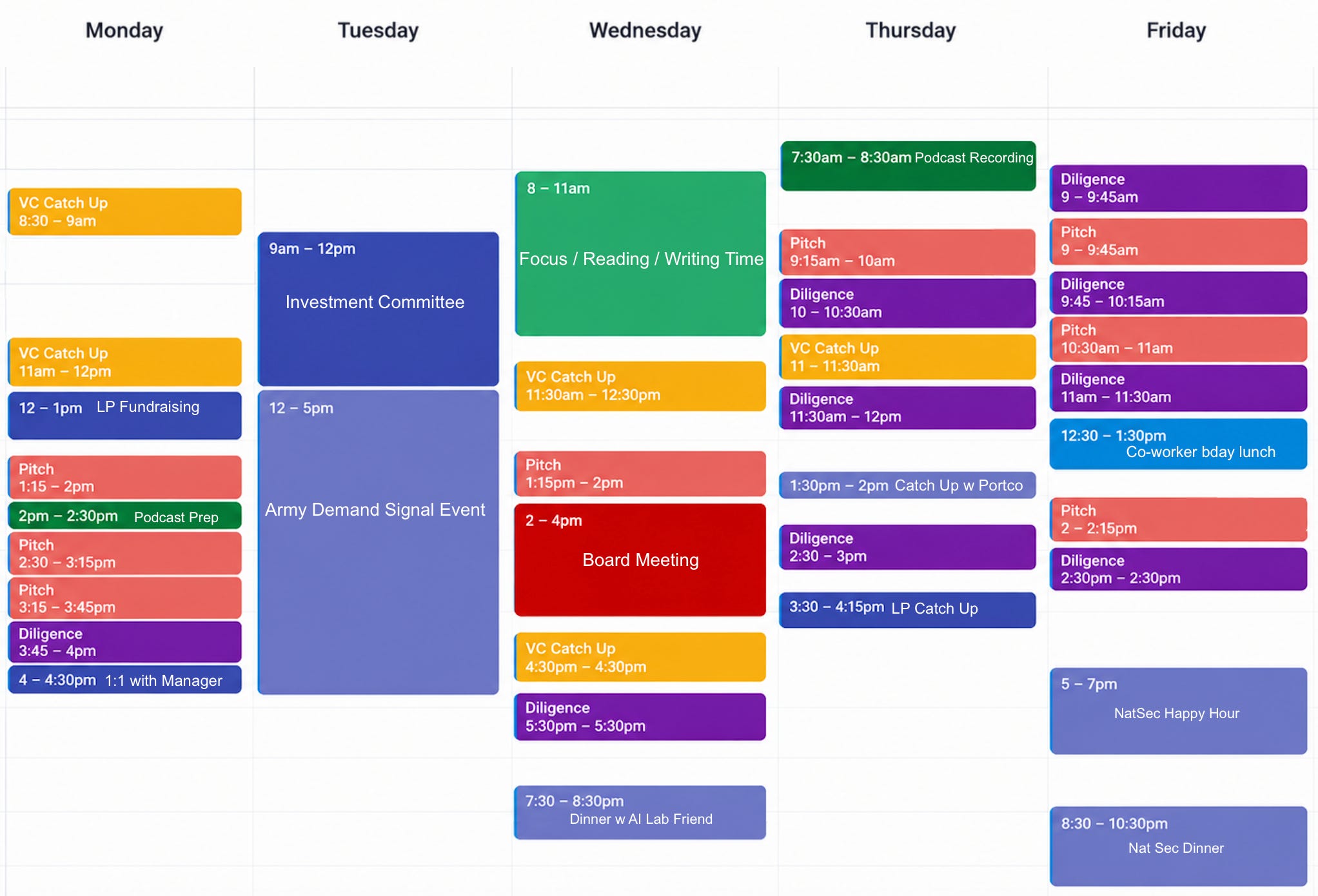
In general I start working between 8 and 9AM (sometimes earlier if there are meetings with folks based on the East Coast or internationally) and wrap up meetings around 5 or 6. I typically attend one or two evening events (happy hours, dinners, etc) each week. In general, I travel around the country at least once a month to attend events or meetings in person (the main cities I frequent are LA, SF, DC, Boston, and occasionally New York and Seattle). I try to reserve at least one morning each week for reading, writing, and focus time, as I’ve found I focus best before noon (however, often I end up doing this focus work in the evenings after a workout / dinner or on the weekends, as my weeks tend to fill up with meetings).
Sourcing and Founder Meetings (~5-10 hours / week)
Taking first pitches (“sourcing”) is the core bread and butter of my job. On average, I take between 5 and 20 first pitches each week. I meet companies through all kinds of different channels:
Other VCs
Pre-seed investors whose portfolio companies are raising their next round
Generalist VCs that do not specialize in defense or deep tech
Trusted VC peers interested in co-investing or co-leading opportunities
Portfolio company founders / employee references
References from other friends, former classmates, professors, and broader professional networks
Events and ecosystem engagement:
Happy hours
Dinners
Hackathons
Conferences
Tech talks
Accelerators and demo days
Online channels such as Twitter and LinkedIn
Cold inbound outreach through email and LinkedIn
Investment Diligence (~5-20+ hours / week)
If a pitch is particularly interesting, we will conduct “due diligence” on the company to determine whether it is a good investment opportunity. On average, we conduct diligence on ~10% of all the companies that we meet. A diligence sprint typically lasts 3-14 days. Some weeks involve relatively light diligence activity if there are no active opportunities advancing through the pipeline. Other weeks can become almost entirely consumed by diligence, particularly when we are moving quickly to evaluate and win a highly competitive deal. Our diligence process primarily consists of the following steps:
Founder meetings: We aim to spend as much time with founders as possible before making an investment decision to determine whether there is a strong mutual fit. Founder-investor relationships often last a decade or longer and must withstand the inevitable highs and lows of building a company. Mutual trust, respect, rapport, and alignment are critical, and the best way to evaluate that is by spending time together. During this process, we also introduce founders to multiple members of our investment team to gather a range of perspectives on both the team and the business.
Founder references: As early stage investors, we are primarily underwriting the strength of the founding team. So, we conduct reference calls with former colleagues, managers, employees, classmates, and others who know the founders well. These conversations help us evaluate attributes such as grit, intelligence, work ethic, leadership ability, domain expertise, sales and recruiting ability, and the overall capacity to build a billion-dollar company.
Customer diligence: If the company has existing customers or design partners, we speak with them to understand the value the company is delivering and how the product is perceived in the market. We also engage with prospective customers to understand how they evaluate the company relative to alternatives. In many cases, we introduce the company to potential future customers, which allows us to observe the company’s sales process firsthand and gather direct feedback on the product and vision.
Tech diligence: We frequently bring in subject matter experts from our network to evaluate the company’s underlying technology, technical differentiation, scalability, and defensibility.
Market and competitive research: Outside of calls and meetings, we conduct independent research using public sources, expert call transcript libraries, industry reports, academic papers, think tank reports, and tools such as Claude and ChatGPT. This work helps us better understand the technology landscape, market dynamics, competitive environment, and the broader opportunity available to the company.
For more on how we evaluate companies in the national security space, see this blog post. For reference, we ultimately invest in less than 1% of all the deals that cross our desk.

Portfolio Company Support (~1-5 hours / week)
My firm typically leads financing rounds and often takes board seats in our portfolio companies. As a result, we take a “hands on” approach to investing, partnering closely with founders to provide strategic guidance, leverage our network, and help navigate key decisions throughout the company’s growth journey. While we do not have a large dedicated platform team, supporting portfolio companies is a shared responsibility across the firm. Every member of our investment team spends time helping founders, whether through customer introductions, recruiting, fundraising support, government engagement, strategic planning, or tackling whatever challenges are most critical to the business at a given moment.
I am a board observer for two of our portfolio companies and work closely with several others. The main ways I spend time supporting portfolio companies are:
Board engagement: Serving as a board observer and participating in ~quarterly board meetings, providing strategic input and ongoing support to management teams.
Fundraising support: Advising founders on fundraising strategy, conducting pitch preparation sessions, facilitating introductions to relevant investors, and participating in diligence calls with prospective investors.
Go-to-market strategy: Working with companies to navigate the federal and enterprise landscape, refine government and enterprise customer acquisition strategies, and identify pathways to procurement and programmatic adoption.
Recruiting: Leveraging my network to identify and connect high-quality candidates with portfolio companies. I also conduct targeted outreach, participate in first-round interviews during key hiring initiatives, and engage directly with finalists to help companies successfully close top talent.
Market intelligence: Engaging regularly with prospective customers, subject matter experts, policymakers, and industry leaders relevant to our portfolio companies to understand the current market dynamics, emerging technologies, policy environment, and competitive landscape.
Relationship Building and Ecosystem Engagement (~10-20 hours / week)
I am always trying to expand my “luck surface area” by building relationships and expanding my network. I make a deliberate effort to build relationships with exceptional founders, operators, investors, researchers, and government leaders. Over time, those connections often create unexpected opportunities: a future founder starting a company, a candidate who becomes a key hire at one of our portfolio companies, an expert who strengthens a diligence process, a new customer for a portfolio company, a differentiated market or technology insight, a follow-on investor for a portfolio company, a co-investor on an exciting new deal, a future LP, or a trusted advisor who helps a portfolio company navigate a challenge. Occasionally, those relationships become something even more valuable: a true friendship 🙂
You never know where new opportunities are going to come from – I’ve sourced portfolio companies from random happy hours (or even introductions from people I met at random happy hours), and key portfolio company engineering hires from random LinkedIn cold outbound messages! Venture capital is ultimately a relationship business, and the returns from investing in people often compound in unexpected ways.
To continuously expand and strengthen that network, I host ~monthly events around the country (happy hours, hackathons, small dinners, tech talks, etc), and regularly attend events organized by investors, government organizations, startups, industry groups, and research institutions.
The communities I spend the most time engaging with include:
Founders, engineers, and operators outside of our portfolio at startups, national security technology companies (including the defense primes), and commercial technology firms to identify emerging trends, potential investments, and future talent.
Researchers across university, government, and industry research labs to stay informed on technological breakthroughs and emerging areas of innovation.
Government leaders and operators across acquisition, technology, and mission organizations to better understand capability gaps, operational challenges, and evolving government priorities.
Venture investors across stages. Venture is a team sport, and building relationships with other investors helps generate co-investment opportunities, identify promising companies earlier, and support portfolio companies throughout future fundraising rounds.
Job seekers and emerging talent, including students, transitioning military personnel, and professionals interested in joining mission-driven technology companies. I regularly connect talented individuals with relevant opportunities across our portfolio and broader ecosystem. Please feel free to reach out if you’re interested in our portfolio
Market Research and Thesis Development (~5-10 hours / week)
In addition to learning from conversations across the ecosystem, I spend time conducting independent research (apart from targeted due diligence) on emerging technologies, markets, and industry trends. My research draws from a wide range of sources, including newsletters, podcasts, books, expert network calls, academic papers, government reports, think tank reports, and industry analyses.
Much of this work serves as the foundation for investment theses, blog posts, and podcasts. It also frequently evolves into deeper due diligence efforts as we evaluate specific investment opportunities and seek to better understand the markets, technologies, and competitive dynamics surrounding potential portfolio companies.
For a full list of podcasts, newsletters, and some of my favorite books on national security, technology, and investing, check out my reading list.

Podcast and Blog (~5-20 hours / week)
My goal is to publish one blog post and two podcast episodes each month. Each blog post takes ~5-20 hours to write and edit (research-heavy deep dives like my piece on AI and offensive cyber are more time consuming, while shorter posts like this one take less time). Each podcast takes ~5 hours to prepare, record, and edit. I typically spend ~1-2 hours preparing for each episode, 2 hours recording, and another 2 hours reviewing the footage and providing editing notes (from there, our fantastic editor takes over, handling the audio production and creating the visuals for the podcast).
While the podcast and blog are time consuming, they’ve dramatically expanded my luck surface area. I’ve formed genuine friendships with people who first reached out after reading an essay or listening to an episode, helped portfolio companies attract customers, investors, and top talent, sourced deals at the earliest stages, and even connected with LPs who ultimately invested in the fund.
LP Fundraising and Investor Relations (~1-5 hours / week)
It’s not just startups who need to raise money – VC firms do too! VC firms rely on limited partners (LPs) to provide the capital that ultimately gets invested into startups. Fundraising and investor relations are not the primary focus of my role, as we have an amazing capital formation and investor relations team leading these efforts, but I still participate in several LP meetings each week and attend the ~quarterly events we host for current and prospective LPs.
My role is typically to discuss our portfolio, investment strategy, and market and technology themes we’re most excited about. I also spend a fair amount of time with existing LPs exchanging perspectives on emerging technologies, market trends, and the evolving national security landscape.
Conclusion
Overall, I genuinely love what I do and feel incredibly fortunate to spend my days learning from exceptional founders, LPs, engineers, operators, researchers, investors, warfighters, and policymakers. No two days (or two weeks) are ever the same. What I enjoy most is that the job is a constant exercise in learning and iteration. I’m always refining how I spend my time, searching for better ways to identify and support the most consequential national security companies at the earliest stages of their journey (so if you have any suggestions on what I can be doing better or differently, please let me know!)
As always, please reach out if you or anyone you know is building technology for national security. As you can see, my calendar is always open to learn more about the cutting edge of technology and national security.
Note: The opinions and views expressed in this article are solely my own and do not reflect the views, policies, or position of my employer or any other organization or individual with which I am affiliated.
Hi Maggie. It’s great to see you on here. I listen to every episode of Mission Matters. I used to work for Mike B and with David R.
Great piece!