



Based on our latest Techquisition Edition episode with defense acquisitions legend Matt MacGregor of Creative Defense and Defense Tech and Acquisition, one thing is clear: if you want to understand where defense markets are actually heading, follow the budget.
In this episode, we break down the $1.5T FY27 President’s Budget Request, the Pentagon’s infamous “J-books,” appropriations vs. reconciliation vs. supplemental funding, and what all of it means for startups, investors, and the broader defense innovation ecosystem.
We cover:
How the PBR and J-Books relate to Congressional budget bills (appropriations, reconciliation, Iran supplemental)
Why the J-books are one of the most important tools for founders building in defense
Where the DoW is requesting for AI, autonomy, space, and other commercial technologies relevant to startups
As always, please let us know what you think. And please reach out if you or anyone you know is building at the intersection of technology and national security.
You can listen to the podcast on Spotify, Apple, the Shield Capital website, or right here on Substack.
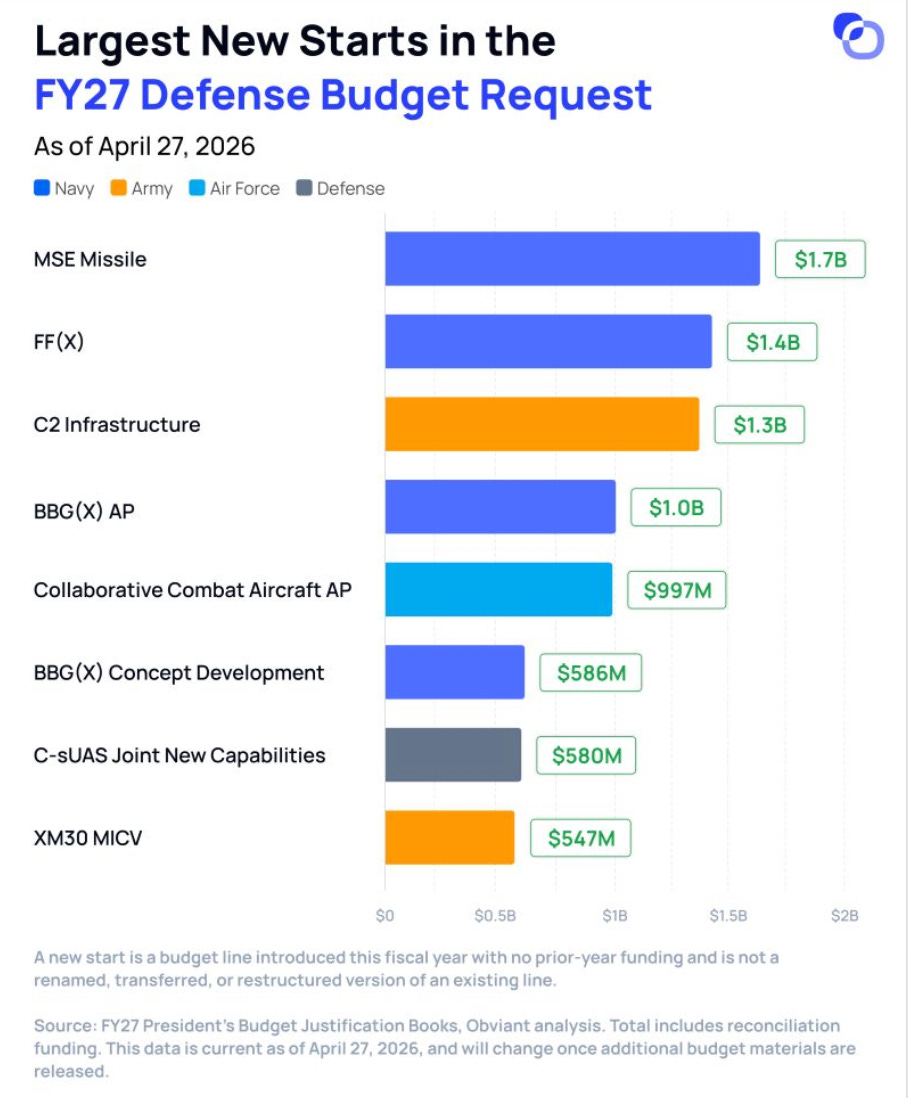
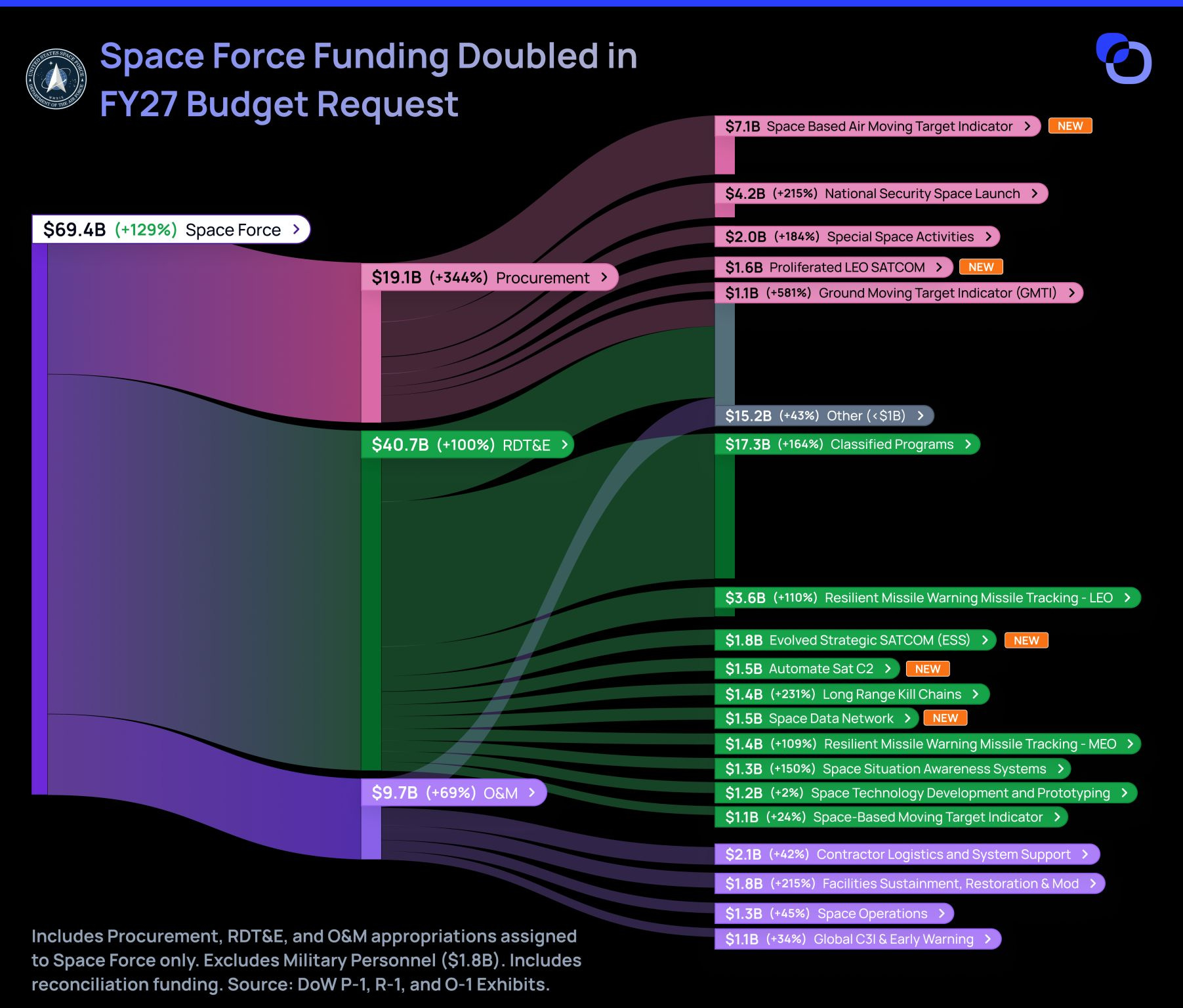
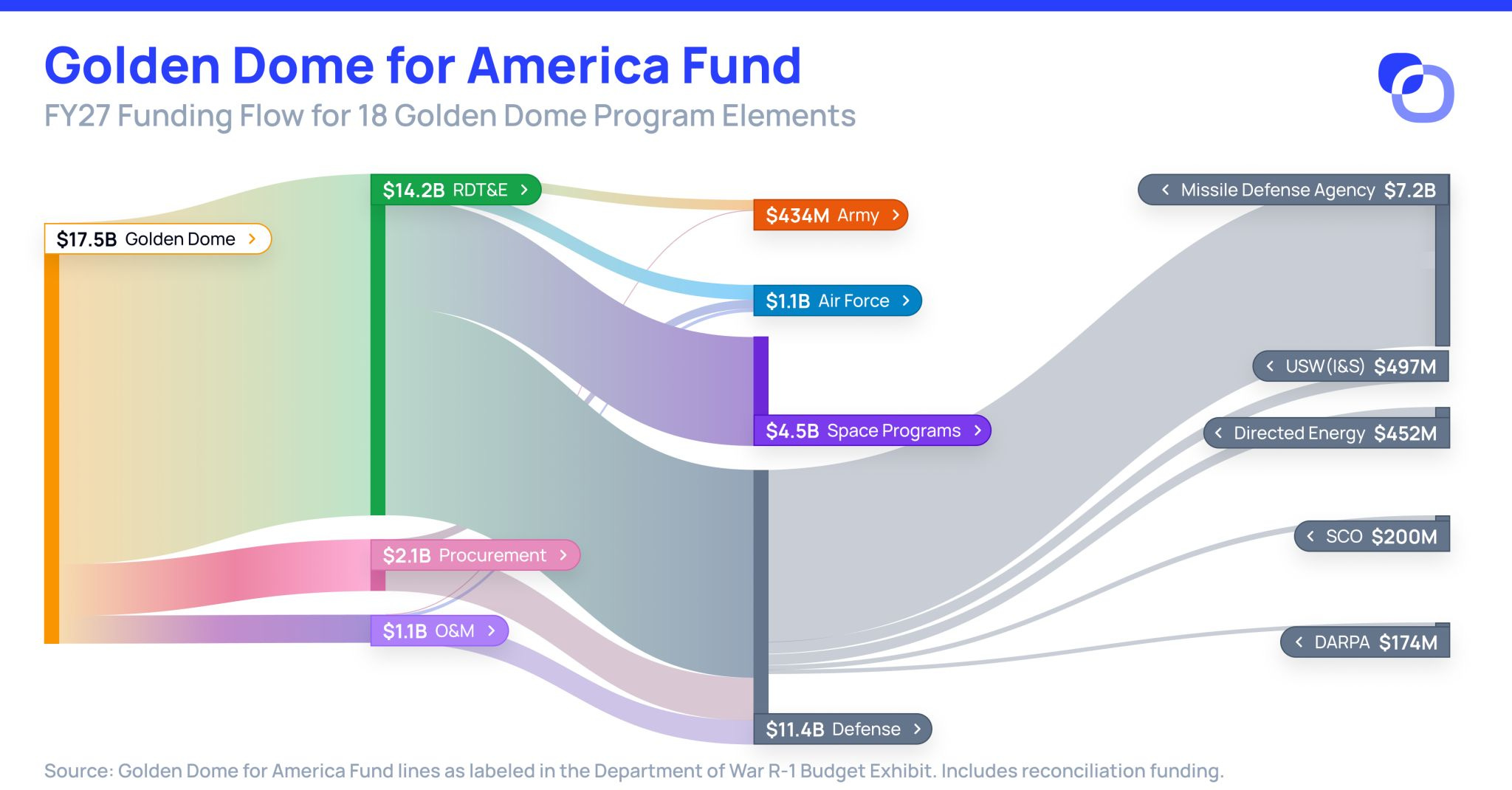
Some obligatory PBR charts courtesy of Obviant:
And of course, if you aren’t already doing so, you should subscribe to Matt’s newsletter Defense Tech and Acquisition:

Transcript
Maggie 00:36
In this episode of the Techquisition Edition of the Mission Matters podcast, we’re diving into an important ritual in the defense innovation ecosystem. That is the president’s budget request, the Pentagon’s program objective memorandum process, AKA the POM, and the release of the infamous J-books, or justification books.
David 01:11
And unlike a lot of defense acquisition conversations that happen behind closed doors, this is one of the few times the government essentially publishes a roadmap of priorities, programs, spending assumptions, and capability needs in plain sight. Though publicly available and well understood are two different things. These budget docs are strewn across multiple websites and dozens of PDFs. Until recently, it took real insiders to understand what was going on and how to make sense of this Byzantine process.
Maggie 01:41
To be clear, the president’s budget request is not the appropriations bill or reconciliation bill. It’s not a law that requires that money is allocated in a particular way. It’s simply what the executive branch is requesting that Congress fund in the ensuing fiscal year. But ultimately, it’s still up to Congress to actually write and pass a budget bill officially appropriating the funds to the executive branch. And while the president’s budget request is a guide to Congress, Congress often does not actually follow the exact numbers written into the request. If you wanna learn more about the congressional appropriations process, check out our past Techquisition Edition episode, that is episode number 17, that we did with Johnny Kaberle, where we really break down how the congressional appropriations process works. But to help us decode the president’s budget request, we’re joined by Matt McGregor, who spends quite a lot of time living inside these budget documents. Matt McGregor and his co-conspirator, Pete Modigliani, are the founders of Creative Defense, and they happen to publish one of the best defense acquisition newsletters out there called Defense Tech and Acquisition News. I personally read it every single week and am a huge fan, have learned quite a lot by reading their newsletters.
David 02:56
Indeed, it is required Saturday morning reading over a cup of coffee. Now, the reason why we are just getting to talking about the president’s budget request is that the timing matters. And while the president’s budget request, or the PBR, has been out for a while, we intentionally wanted to wait until the justification books, or as Maggie alluded to, the J books, dropped, because that is where the budget finally starts to become operationally useful for companies trying to understand where the money may actually flow to. The president’s budget request really talks about a top-line number across the various agencies, not just the Department of Defense, but also including other federal agencies. The J books really start to get into the individual programs to help identify over the next five years or the future year defense plan exactly how much funding is gonna be going and whether or not that budget is intended to increase or decrease.
Maggie 03:53
So today we’re gonna break down how the federal budget process actually works, why the president’s budget matters, what the J books are and how to use them, what stood out to us most in this year’s defense budget, and what all this means for startups trying to navigate the defense market.
David 04:10
And because this is a Techquistion Edition, we’re also gonna talk about where the hype is real and where programs may actually have money behind them, and where founders should be careful not to confuse PowerPoint strategy with executable budget authority.
Maggie 04:23
All right. Well, with that setup, let’s bring in Matt.
David 04:27
Well, Matt McGregor is a co-founder of Creative Defense and a co-author of the Defense Tech and Acquisition newsletter, which has become required reading for a lot of people trying to understand how defense budgeting, acquisition, and modernization actually works.
Maggie 04:42
Defense Tech and Acquisition news, it’s not just a weekly headline roundup. They actually spend an enormous amount of time digging into the underlying budget materials like the J books other, documents that are coming out to really identify where priorities are actually translating into real dollars.
David 05:02
Okay. So with that it’s an honor to welcome my longtime friend, Matt. Welcome to Techquistion Edition.
Matt 05:09
Yeah. Thanks for having me, you guys. Appreciate it.
Maggie 05:11
So Matt, let’s just start out with a basic question. At a high level, how should people be thinking about this $1.5 trillion defense-related spending package? What exactly is the president’s budget request? And then how does this relate to the emerging reconciliation package as well as the annual appropriations bill? What are all these different documents?
Matt 05:37
Yeah. We used to live in a simpler world where there was one budget and we got to track that. And then this year is even a little crazier because there’s gonna be three pieces, I think, that potentially play into what the total ‘27 budget’s gonna be The base budget of course, is 1.1 trillion, so even, by itself that’s still big. If we got that, I think that’d be, a huge win. Definitely getting in the right direction for all the challenges that we have. They added 350 billion on top of that for reconciliation, and then the other piece of that is there’s a supplemental, right? The Iran war. So there will be money in there that will impact the investment accounts for sure on the procurement of munitions. But also some other things in there. I think there is some debate on the Hill. I’m not the expert on all that, but there is some debate on the Hill about is a second reconciliation even possible? ‘Cause they just got the DHS one they’re working now, and there’s a lot of thought that the second one’s gonna be too hard. So there’s some push of well, do we try to cram some of the defense stuff into this first reconciliation bill this year and make that the big package, or do they do a second one and push it, or they push more on the supplemental? So still a lot of moving parts, but the only thing we officially know right now is there, there is a 1.5 trillion, a big part of it, the 1.1 is discretionary. The rest is up for debate on one of these other mandatory accounts.
Maggie 07:12
So just to make sure I’m understanding this right, so we have the president’s budget request, which is out, and this is just a request to Congress. It’s not actually the budget. Then we have the $1.1 trillion appropriations bill, or what we expect would come out in the appropriations bill, which is just the normal spending bill, and then another 3 to 400 billion that would come through some combination of this reconciliation bill, which is not a normal funding process, and then potentially a special bill just for the Iran war.
Matt 07:41
Yeah, the really only difference is that the, for the reconciliation, is that in the Senate you typically need 60 votes to, to pass a bill. With reconciliation you just need a majority. So that’s the difference is the 60 votes in the Senate primarily is the difference.
Maggie 07:57
And so when we look at the president’s budget request, I know one of the big topics of conversation is there’s different colors of money, right? So you have procurement money, RDT&E money, and O&M, which is operations and maintenance money. So maybe could you talk about what are those three different kinds of budget, and what is the breakdown between those categories in this budget request?
Matt 08:20
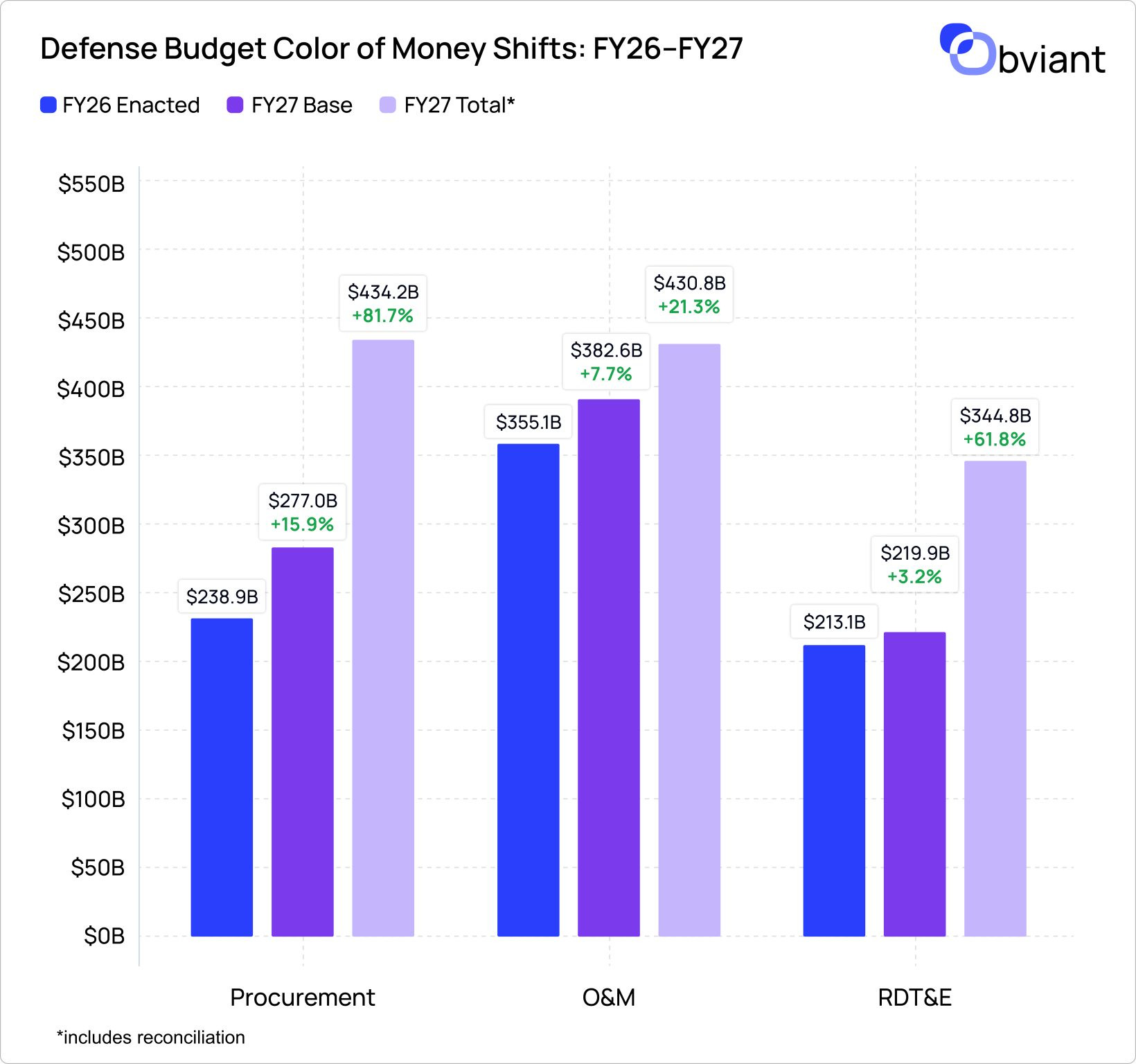
Yeah. So yeah, the big difference O&M is a big pot of very flexible money. Some of that can be used for, capability for sure especially as we move into an age with buying services, capabilities of services. But generally the O&M, and it does fund a lot of modifications to legacy platforms and things like that, but generally a lot of that goes to sustaining, right? Just keeping the existing things alive maintained, ready, all the readiness stuff, all the, you know- Just general housekeeping kind of things that, that DoD needs to do. But where we really focus, for the founder groups and for all these defense tech companies that are coming out, they’re generally more focused on the investment accounts because that’s where you’re gonna see your RDT&E dollars. This is all your prototyping, moving into a program of record, all the development test is funded on that. There is some big modification money too in there that sometimes, will be maybe become available for founders as they mature a capability that can be fielded on an existing platform. So RDT&E has a lot of potential for people that are entering the defense space. Procurement, of course, is more of those m- mature things where there’s we’re actually fielding them. So that’s the one where it gets down to there’s actually a production line or there are some software kind of things in there too, but generally it’s the big stuff that you see flying around tanks and missiles and all those ships and all those kind of things in there that that are there. But just going back to the overall breakdown, so within the base budget, and that’s the discretionary, there is $1.1 trillion. 218 of that is RDT&E, 257 is procurement, and then a big chunk in O&M, 382, and then some of these other accounts like military personnel and military construction. So of the base budget, you have, basically, 470 billion of the 1 point trillion. But in the reconciliation package, there’s a much bigger chunk. A lot of that is investment.
Maggie 10:37
And then Matt, I also wanted to ask, how do we think about the ratio between procurement to O&M to RDT&E funding? I know this is something that you’ve written about before. What can we read into the ratio of the current budget request?
Matt 10:51
Yeah, no, this one is a really exciting thing because we, we wanna see more in procurement. I know it’s not always the right thing for some of the smaller companies coming through ‘cause they, they really want that RDT&E money to seed some of their products. But as a military force, right, we definitely wanna see procurement to get the joint force up and ready for the future fight. We know in the China fight that there’s, we’re gonna, we’re gonna go through a lot of stuff really fast if that happened, and so we wanna be prepared to be able to stay in the game. So yeah, this year there was a big push towards increasing procurement 80 per, 82%. Now this is combined, combining like we talked about discretionary, mandatory. It’s combining both of those. But when you look at the combined piece, 82% increase in procurement from last year and 62% increase in RDT&E. While the percentages are not totally different from past years, like we always measure that- And they’re still in that roughly 57% procurement, 43% RDT&E. A lit- 1% bump up in procurement. So the ratio is not totally off, but because the numbers are so substantial it’s promising to see that much went into procurement. But a lot of those big procurement dollars were in reconciliation were basically driven by a lot of the missile stuff, a lot of the Golden Dome stuff, a lot of the space stuff, and things like that, that were in those accounts. We definitely need reconciliation for some of these big items.
David 12:18
Yeah, I think that is an interesting indicator. For a long time it seemed like the R&D spending, outpacing procurement not necessarily what, a venture-backed startup is looking for. And there’s almost a recognition that some of the R&D costs can be underwritten by the private capital markets, right? Especially when you introduce OSC that’s de-risking some of these loans, allows more money to pile in. And then really what the signals that are needed from the commercial innovation ecosystem are just buy the thing, operationalize it, use it, right? And that’s where you get the procurement and then O&M funding on the follow-on. But Matt, that was awesome. Thank you for helping us understand the top line, right? I think we call that the TOA, ... inside in, in building parlance. Maybe let’s dive into the actual nitty-gritty of the J books or justification books, which are essentially, the government or the executive branch saying, “This is why I am requesting this amount of money.” Right? What else can you see inside of these J books, and how are they broken down, and what’s useful information to extract from them?
Matt 13:41
Yeah, that’s a really good question because we were talking offline about, if you’re an AI company, for instance it can be a little bit confusing because you could look across all the J books, and I just did a quick search, and there’s 431 lines, right, across artificial intelligence. So clearly if you’re an AI company, there’s... That shows there’s a lot of potential but you do have to do the hunting for where is your particular thing going to fit into one of the broader efforts. So there is some detective work, if you wanna call that here that you have to do. But one of the helpful things with the J books that I would encourage, companies that are trying to figure out where their piece might fit in- Is if you go into the JBook, they can be a little daunting because there’s kind of these PDF files that’s hundreds of pages. But you can, do some keyword searches. Aviant is a company that y- also has a great tool that you can do searching and it’s a little much easier to m- navigate. But if you wanna do it the hard way, go in that PDF file and find s- a line that looks y- like something that you could support. So you’ll have to, you’ll have to flip through and you’ll see things like artificial intelligent reinforcements autonomy AI-enabled tools, AI-enabled DW. Like I said, there’s a little bit of detective work, but when you click in that line that maybe has some applicability, you think, to, to what you’re doing one of the helpful things is that there are m- things called major thrusts. And what that essentially just means is in that bigger budget line that maybe is like $100 million, you can actually go down and see more discrete projects under there, and you can say maybe this project has $10 million against it, this project has $20 million against it, and there’s a little bit more detail about what that’s about. And then sometimes they even have a helpful schedule with some milestones. Their schedules are weak generally, but you can at least see generally the flow of what they’re trying to do. And then I think the next step is if that’s something that really looks like, hey, I could really help here, is go figure out is that something that’s already been awarded? So you can start to tie that information, do some other searching and find out if there’s, already contracts against that. And what’s their period of performance? Maybe they’re coming up for a re-compete, or maybe it was just a prototype and there’s still, there’s still money in the FY DIP that, that you could potentially get after. So I think those the J-books are good signals for companies to be able to filter down and find their target areas for where they can see potential for contracts or maybe target customers. “Hey, I should really talk to this customer a little bit more because they’re planning this big thing that has exactly what I’m working on.” So they won’t tell you everything, but I see them as a signal to direct your attention. But yeah.
David 16:28
Yeah. And as a former author of my own RDocs for specific program elements, PEs, which are associated with these wonky, string numbers and letters, they’re not all, RDocs or R2s, which get down to the specific program elements, are made the same. Some have a lot better detail than others. Oftentimes you can see which other program elements one is related to, and so you can go check out them. And when you’re talking about, looking at the schedules or potential contract structures, it’s in there. I would say, maybe you brought up Aviant. I think a really nice thing about some of these tools that are helping aggregate all this publicly available information Is it’s now also creating the relationships between the budget, the program office, and the contracts. Because in these justification books, it’ll tell you, “This is the money we intend to spend against these priorities,” but it doesn’t necessarily tell you who or where, like what program office. Now, in certain cases it’ll say, Defense Innovation Unit, and Defense Innovation Unit has a program element ascribed to this, like this amount of money. Okay, DIU is expected to execute it. Of course, in those instances it doesn’t necessarily tell you exactly what projects or programs or who the end customers are that are going to be receiving it. This is one piece of the puzzle, but I think if you’re looking for market demand signal from the department about whether or not the technology you’re building is important, you will see that laid out over the future year defense plan if, in fact, it’s expected to grow over years. Well, that was awesome. Thank you, Matt. Maybe we just start talking a little bit about w- where and different line items that we thought were interesting and stood out. And Maggie, maybe if you wanted to start us off here and anything that you found that was interesting, we can go around the table.
Maggie 18:39
Yeah, of course sitting in San Francisco I always have to look for, do my keyword search for artificial intelligence. Where is the department looking to fund that? It’s something the administration has, of course, made a priority. The top line, it says there’s $53 billion for AI broadly. A lot of this was actually going to sovereign AI. They did not specify exactly what sovereign AI here means, but said something like 50, $46 billion for multi-year mandatory investment in a sovereign AI arsenal prioritizing enterprise-scale AI infrastructure investment to build an enduring strategic advantage. They actually have not released the J-books yet for the Chief Data and AI Office, at least as of the time of this recording. So there’s not more details on what exactly that means, but definitely will be interesting to see. Of course, a lot of these big AI data center build-outs, AI training runs are extremely expensive, so it would be interesting to see if there’s a way for the US government to play into some of the investment in American AI development. I also saw AlphaOne, which is one of the platforms that Chief Data and AI Office, CDAO, runs, got a big increase in funding. But then at the same time it appeared that CDAO itself actually got a decrease in funding. So I’m not entirely sure what to make of that. Matt, I don’t know if this is something that you’ve tracked at all or have more insight into.
Matt 20:07
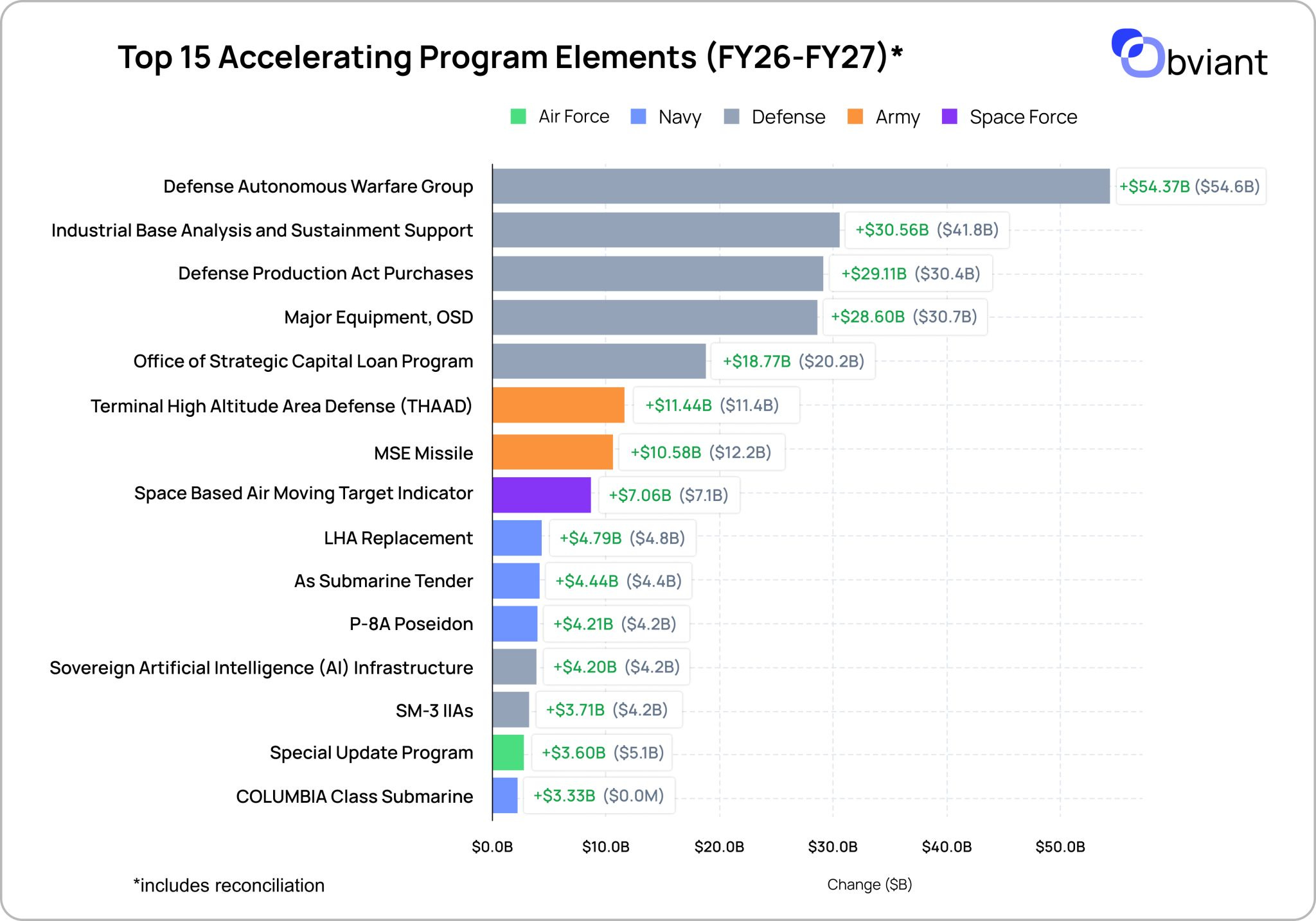
Yeah, I do think with CDAO getting pulled under R&E I think and DIU for that matter- I think both of them are being recalibrated and having a little bit more targeted portfolio. So yeah. So I think, for CDAO, I think you’re gonna see, the OpenDagger stuff continue the guide experiments and the, data integration layer sort of efforts. And then I think AlphaOne, I think that- that’s probably something they’re gonna own as well ‘cause this could have some frontier AI and some theater cloud sort of efforts. So yeah, I still think CDAO is gonna be highly relevant. I wouldn’t take too much signal that they’re losing too much, but I think you’re right that there’s the department, as part of its whole requirements revamp, they definitely have refocused some efforts and so yeah, I think there’s a lot more lot more of that focused on the multi-domain joint operations stuff and long-range kill chains and different things like that, that maybe took a little energy away from CDAO but I think they’re still quite strong. One other interesting thing on the AI front, though since you brought that up, that I noticed is I didn’t see-- I looked at the J-books. The J-books did not-- were... When they when they first released the budget without the J-books, I saw this OSD equipment account, which historically has been ATFWIT money, been the predominant piece of it, and it got this huge plus-up, and I was really excited because I was like, “Oh, yeah, ATFWIT’s finally gonna get its huge bump,” because it’s been in the $100, $200 million range, and I was like, “Oh, maybe that’s gonna go to a billion.” Anyway, I finally saw the details on that, and there’s $29.5 billion that’s going to this effort called Next Generation Technology and Autonomy. And the way it’s described there is that it’s basically to trans- transition from funding scattered clusters of GPUs to more organized AI infrastructure for strategic to tactical AI compute, so in- it’s gonna include SCIFs and data centers and all this stuff. So anyway, that’s something interesting to watch on the AI side is that OSD equipment account which this was buried under.
Maggie 22:17
Yeah, and then maybe something similar I also saw this is actually under the Cyber Command J-books. They have a large line item for AI for offensive and defensive cyber operations. I think it’s $140 million, so maybe not a lot for the DoD, but a lot for some of these early-stage startups. And part of that for them was also building out GPU capability and other compute capability to actually run some of these AI models. I know to date when working with some of these more classified customers, I’ve heard startups talk about literally bringing GPUs in suitcases or in Pelican cases loaded with open-source models to the customer ‘cause they know they can’t rely on the customer having the right infrastructure to run these models. So I think it will be interesting to see just more of the infrastructure build-out for DoD to actually take advantage of a lot of these AI models. And then one more AI related item I’ll call out. I saw Maven’s smart system has $2.3 billion budgeted. This is, of course, one of the big AI initiatives. They have played a large role in Iran in targeting and battle space management. I think there’s also talk that it played a role in Venezuela. This is a Palantir effort, although it also has some Anthropic Claude models built in, and it was announced last month that it’s officially becoming a program of record and now has $2.3 billion going towards it.
Matt 23:42
Yeah, no, I think that’s a good rundown.
David 23:44
Maybe one that I’ll call out right from my alma mater at Defense Innovation Unit. So I think this is a good example of where the president will submit a budget to Congress, but, Congress, as we know, has power of the purse, and they get to then ultimately decide how much funding is going to go into these specific accounts, and then the department is responsible for executing it as authorized, right? We don’t want any Misappropriation Act violations, right, Matt? But if you look at the DIU account, and of course, they haven’t released the specific J books, but we’re seeing the top line program element n- numbers for the OSD accounts. DIU, right, came in at five hundred and twenty-two million. Last year, DIU got one point eight billion, and so you would say, “Oh, well, that’s a far cry from what they got,” except the president’s budget request last year for fiscal year ‘26 was a hundred and forty million. So what we’re seeing is Congress has stated with congressional plus-ups that programs being executed under DIU are very important, and now we’re finally seeing the president’s budget start to catch up, though that is a huge delta between one point eight billion and five hundred and twenty-two. So it’ll be interesting to see if Congress for the third year in a row pluses up the DIU account, right? And that started to really occur I guess j- two years ago when DIU’s budget and program element really got congressional plus-up big time. Those are things that I think are interesting.
Matt 25:21
I was initially discouraged by that one too, David, but then my understanding is that a lot of the DAWG funding, they will be intimately involved with executing. If that passes, they will have more work than they can handle. So maybe taking a little cut to, a little cut in relative terms to the DAWG request maybe it’s not such a big deal ‘cause we’ll have, fifty, fifty billion to possibly do some thing, things with over the next few years.
David 25:51
And that’s why I think seeing the J books is so interesting ‘cause you can start to see how are the different program elements interrelated with each other, right? So like another one that, I think is a closely watched item right now is Golden Dome And, it’s really-- There are definitely some explicit program elements tied to it. In fact, you saw a $1.3 billion request for space-based interceptors, specifically under a PE inside the Golden Dome apparatus. But if you look across a lot of other Space Force programs like Next Gen, Overhead Persistent, Infrared, e- and OPIR, or the, Matt, you referenced the Satellite Defense Network. They’re all talking about how these programs support initiatives within Golden Dome, and that’s a political crutch that you’ll see often within these budget documents, that you tie these programs intricately together so that if Congress wants to just cut one, you know that there’s a reciprocal effect to maybe a higher priority program that they don’t want to impact. And so you see those types of machinations. And again, you can extract that through the J books, where there is just a little bit of nuance across these, otherwise stovepipe program elements. But Matt, you highlighted the Defense Autonomous Working Group, the DAWG, right, which is all about mass and attritable capabilities. Was there anything else, like maybe on drone dominance or the JIATF, the counter-UAS programs that were worth highlighting?
Matt 27:31
Yeah, no, a lot of lot of stuff with the DAWG is definitely gonna be a lot of the autonomous systems, definitely drones, small UAS small USVs things like that. But yeah, if I go through, just if I do a quick run-through of the services maybe just call out a couple things here. One o- one overall is that and this is another one, David, you mentioned about how Congress sometimes steps in and helps, is the S&T accounts. Th- Congress is definitely known for giving more money back in the S&T account, but I do feel like there was definitely some slashing going on there across the Army and Navy. There was a 30% kind of reduction in some of those accounts. But on the Army side, while they slashed a bunch of other things across a bunch of different areas, they really went hard on counter-UAS, counter-small UAS. So I think you’re definitely gonna see more focus on that with all of the things we’ve seen in Iran. Long-range precision fires is definitely a priority, so for the Army and EW. So I think you can start to look at some of these accounts, and even when there’s big reductions overall, when you start to dig in, you start to see, okay, this is where the Army is probably heading. Their leadership is thinking is they need to get after and focus their efforts a little bit more on counter-UAS, long-range pr- precision fires, and EW and then when you look at like prototyping stuff, you can start to see where some of these accounts are starting to be a little bit maybe less prioritized because there’s other programs that are growing, and so maybe they need a little less prototyping money because they’re gonna be programs of record. But you can start to see that they actually do wanna get after some, new types of missiles and improve their ability to do more mobile stuff. So I think that’s one of the big things too, is like there’s a lot more focus now on being able to operate in a distributed manner. I think you guys nailed it with the AI thing about being able to get to the tactical edge and pushing things forward. So some of these things you start to see as they’re really starting to focus 100% on the INDOPACOM theater, and a lot of those things reflect it. And hypersonics is a theme throughout all of this that, if you have anything to do with hypersonics realm, there’s definitely a lot more money going in that direction. Yeah, some of the other cuts you do see, I think there are some opportunities here for some of the legacy programs. I I saw things like the Army Tactical Command and Control where, you know, some of these existing efforts just had money at year after year and there was some big pullback there. So that’s another thing to look for in the J books as an opportunity, is if you see a legacy program that’s maybe gotten a lot less money than it normally would that could be an opportunity for you to step in and maybe offer some solutions that, for that. So yeah. So that’s one I would call out. UAS Launched Effects got a huge plus-up from the Army so four, four hundred and forty-three million there. So if you’re in the loiter ammunition business that’s definitely, a signal that I would take as they’re definitely more serious about that. That’s like over two hundred percent increase from last year. And then yeah, going down to the Navy. Yeah, Navy took a big, real big cut to S&T as well. So Marine Corps, had a big cut on their advanced technology demonstrations, which I think you will see with this administration, and it’s something to expect maybe over the next couple years, is there is a really big focus, I think I think you saw this with the critical technology areas update, where we had sixteen amorphous tech areas, and they really winnowed those down to things that are applied, things that could be fielded, really focusing on getting things out in the field and not doing these sort of long science projects. So I think some of these cuts in the S&T world reflect that. But definitely on the Navy side, big push on shipbuilding. If there’s any contributions that you can have to the shipbuilding helping in the industrial base in any way whether it’s from workforce development, to new kind of materials and new manufacturing processes and things like that, there definitely seems to be a big push to make help in any way on that as part of the maritime industrial base. There was one point eight trillion that was added to this new line called Advanced Shipbuilding Industrial Base and Future Ship Experimental. So that’s something to keep an eye on. Big increases on Marine Corps ground combat support systems. So if there’s-- you have a system that’s more focused on supporting those Marine type, d- expeditionary type units, they’re definitely looking for new ideas. If that’s any indication in terms of how much more money they added there. Directed energy i- is getting a lot more money. You start to see that. There’s more programs coming online. Navy has some, Army has some, so that’s another area if you’re in that business. F-35 probably not a lot there out there for small funders. F-35 definitely got a lot of money this year. EW across multiple accounts got some big plus ups. So I think if you’re in the EW space, there’s probably... You could look across all the J-books, and you could probably find multiple places that you could start to have conversations at the right levels and start to play in that space. EW sup- readiness support was one line in the Navy, one that got a big increase, and then Marine Corps also got a big increase in that line, three hundred and fifty-seven percent.
Maggie 33:12
Yeah. I was gonna say, one thing I was curious about, I think we’ve seen a lot of talk in the last year or so about acquisition reform, moving from PEOs to PAEs, program acquisition executives, and I’m curious to what extent, if at all, that is showing up in the budget. I saw that PAE robotic autonomous systems in the Navy had its own call-out in the Navy budget overview. They had a couple hundred million each for unmanned underwater vessels, small unmanned surface vessels, unmanned aerial vehicles. So I’m curious how we’re seeing the PAEs show up in this budget.
Matt 33:49
Yeah David mentioned the Golden Dome stuff. That was one of the big ones. But yeah, for the so I didn’t see a lot of it at the like the Army and Air Force because i-i-it, there’s a lot of nuance there with those services. The Navy, because they stood up a brand new robotic autonomous system, was a little bit more clear. I think on the Space Force, on some of the new PEs that have been stood up there, like the space-based interceptors going to combat power and then the all the space data transport and AMTI and GMTI going to the SB, space-based targeting PAE. You could start to see some correlations there but I do think you’re right. I think the PAE RAS was the most clear and explicit and they actually laid out the specific programs under that and the amount of money across the FYDP, which was which was really helpful to see, small USVs, medium USVs- the one sad thing about this is that we’re still not seeing the amount of money go. While they called it out and it’s very well organized, we’re still not seeing the increases that we wanna see, so they do have 2.2 billion across all the unmanned accounts, but it’s a lot less than we would’ve liked to see given the focus on building a hedge force. But yeah.
Maggie 35:09
And David, how’s the Air Force looking?
David 35:13
Yeah. So Matt, you talked about all the other services and components except for your alma mater, right? The Air Force- Oh yeah, I was about to-
Matt 35:19
I know. I was about to. I was getting there…
David 35:21
I, well, I have some opinions here, right? So collaborative combat aircraft, which seems to be the Air Force’s big push-
Matt 35:29
Ah. I know. Where’s the money? Where’s the money?
David 35:32
I mean, 1.3 billion in the fiscal year ‘27 request, but that’s less than what the B-52- Yep ... is getting in budget activity seven, I think for their engine upgrades, which is 1.4 billion in RDT&E. So we are spending more money to maintain an aircraft that’s been around for multiple generations, and then when you contrast it to the F-47 right, which is, went from 2.3 billion in FY25, now is up to five billion in ‘27. To me, these are, like, the specific trade-offs between incorporating autonomy versus relying on manned fighter aircraft, and it’s so much more expensive, and we don’t really get to invest the budgets that we need to get to a force structure where we have more mass. And so I don’t know what’s your kind of take on the Air Force overall? I also saw AFWERX got completely decimated. Yes. They’re basically just a SBIR shop at this point, which is really sad to see though there have been some announcements coming out of AFRL that they’re reorganizing and there’s a big meeting happening in a couple weeks to help engage industry. But yeah, curious on your takes with our beloved Air Force.
Matt 36:48
Yeah no, you’re right. I was gonna say that about the AFWERX is I am hopeful that the reorg that General Bartholomew has will hopefully keep the AFWERX mission alive if it’s, if not the organization. No, yeah, I think overall I think there was disappointment that there wasn’t more of a focus on autonomy, but I think you do have to look at where this administration’s focus has been, and it, it has been on mainly building on the, getting the big ships fielded, getting some of these big new aircraft programs going, like the F-47 and accelerating the B-21. And then on the Army side there, there’s, there, there is a shift there at least from the big tanks to moving to- towards more distributed kind of things, but still not fully leaning into the autonomous vehicle space. So I think overall with autonomy, it is a little disappointing. The Air Force put a little bit of down payment there on the CCA, but would’ve liked to see that be triple that. I would’ve liked to seen the Navy go, at least triple to really get after the MUSV, which they just announced a new marketplace. A better demand signal there would’ve been a lot more money next time. And then, yeah, for the Air Force overall, they’re retaining a lot of the same aircraft. They’re gonna extend the B-1. They’re gonna, extend the F-15 EX they’re buying a lot more of. And there’s one other aircraft. Yeah, they’re gonna keep the A-10 till 2033 or something. So yeah, there’s a, there’s definitely a more higher prioritization on the big platforms that historically we thought would be maybe less relevant in the Pacific Theater, but I think they are leaning into that, and hopefully we’ll see in ‘28 that’s the one gonna be the one to watch. If these programs, maybe they were not mature enough to make the case in the building, people could say, “Well, the MUSVs are still haven’t fielded that many of them. We haven’t matured the CONOPs.” Same with CCA, right? The experimental operations unit’s still playing around with the CONOPs piece. So maybe this is the year, ‘26, ‘27 is the year they see data as maturing all that, and then they’ll go hard in ‘28. So I have high hopes for the ‘28 budget on those fronts.
David 39:04
At least they did try to zero out Wedgetail the E-7. But we’ll see.
Matt 39:09
Oh yeah they did kill the E-7. Yeah.
David 39:11
We’ll see. I’m sure Congress is gonna plus that back up, so of course that’s a trade-off, and we’ll see where that goes. But yeah, okay. So I think we, we hit a lot of areas. Of course, for our founders out there, this is certainly far from everything, that’s in this defense tech innovation ecosystem. But again, this is a huge marker to help identify is the thing that you’re building an emerging or an already solved pain point, right? And whether or not there are active programs of record with specific vendors that you would need to break into. This is a good data point to, to bring into your marketing materials, whether you’re trying to raise from investors or talk to customers or differentiate your technology versus what’s currently available. So yeah, this is a big step in the process, but, where do we go, where do we go next? So we’ve got the president’s budget. We’re already seeing senior leaders testifying on Capitol Hill, to defend the budget, and so you’re seeing a parade of generals and senior executive civil servants and appointees articulating the merits of this budget. And then what? Congress goes into a black box, and they start figuring things out. What happens next, Matt?
Matt 40:37
Yeah, I think you’ll see some of the initial markups on the approps bill in the June timeframe. So hopefully we’ll get to see... Yeah, your point on the E7s a great one because, yeah, we know some of these things they will add back in. I think by June we’ll also have a little bit better sense of where reconciliation is going. So one thing that you could see the Hill do is really have to make that balance of if they can’t get that 350 billion, they’re gonna have to fit all of their priorities in with all of the other budget requests. DAWG, maybe DAWG if the reconciliation bill doesn’t look like it’s gonna happen, maybe they take a piece of that. It’s not 43 billion, but maybe they, support five billion or something like that. So you could see some of these accounts shrink, but hopefully move from reconciliation into the base budget. And then, yeah, they’ll pr- they’ll bump up all their priorities, but we’ll probably get a first look at that sometime later in June. And then yeah, we’ll see how things go with the supplemental, which will help, also help inform do they have to move more money to missile accounts to, to compensate if the supplemental hits a snag? Will they try to push maybe some of these really big priorities they know for the President? I don’t know if you picked up on that, but when you looked at the one of the things that I’d never seen before in the budget overview from OSD, they actually had the table, the pi- the pie chart, and they had a slice of it that was, like, presidential priorities, and I think that was, like, maybe a little signal that if you don’t fund these things you’re gonna get a call from the White House. So it will be interesting to see as they’re moving through there what things, what are the, what part of the presidential, President’s priorities move from reconciliation possibly into the base budget, and then what things get decremented. So yeah, I would say June and then there’ll be there’ll be some defense of that, and we’ll see the we’ll see the final hopefully before October. But time will tell.
Maggie 42:30
Great. Well Matt, thank you so much. This was incredibly informative. I know the federal budget process can feel very opaque and archaic to those of us on the outside. I was feeling a little bit of despair last night downloading the J books, trying to figure out what all the different acronyms mean, trying to figure out which of the 900-page PDFs, each item that I was interested in fell into. So it’s always great to talk to an expert like you. And of course I read Defense Tech Acquisition news like the Bible to really help me figure out everything that is happening in this space.
Matt 43:08
Thank you. Appreciate it. Thanks for having me.
David 43:10
Yeah. No better way to start your Saturday. Though I would be remiss not to highlight, right? This, the President’s budget, and we still haven’t seen all the J books come out, very late to Congress, right? Yes. This is something that’s supposed to happen in February traditionally. And so we’ve squeezed Congress who already seems to be-
Matt 43:29
Actually by law.
David 43:31
Okay, by law. So we’ve already squeezed Congress on their timelines- to get out the NDAA and the appropriations bill to do all of their horse trading and back and forth with the department. So all but I can say this is an interesting time for people at the Pentagon as they now have what’s called staffer days, where they start to defend the budgets that they’ve been putting together for the better part of 18 months encapsulating this entire POM process. So yeah. Well, Matt, thank you so much for joining us. It’s a pleasure to have a real subject matter expert like you. We missed having Pete on the podcast as well, but we’ll try to maybe we’ll get him next time for a different topic.
Matt 44:16
You bet. Nice to be here. Thanks for having me.
Maggie 44:19
Wow, Matt was really great. He definitely knows his stuff. The federal budget process can feel incredibly opaque, but conversations like these really help translate what’s happening inside government into actionable insights for the broader defense innovation ecosystem.
David 44:36
And for the founders listening, the key takeaway here is simple: The budget is strategy translated into resource allocation, and if you wanna understand where defense markets may emerge over the next several years, you need to understand where the government is placing its money, not just where officials are giving speeches.
Maggie 44:53
And of course, if you aren’t already reading Defense Tech and Acquisition, you definitely should be. Again, Matt and Pete are seriously consistently doing some of the best work breaking down what these budget documents actually mean. So David, I have to ask the question that we end every Techquistion episode with. What do you think the next Techquistion Edition episode is going to be about?
David 45:14
Well, I think we alluded to it a little bit given that we’ve got three budgets in one that are being bandied about, right? Between the president’s budget or the base budget or the discretionary budget, then you’ve got the mandatory budget or what they’re calling the reconciliation bill, and then this extra funding, geared towards specifically the actions in Iran. And I would imagine that we may be talking about one of the latter two, either the reconciliation budget and what was in it and what does that mean for startup founders and the programs that money’s tied to, or for any supplemental funding that’s tied to the Iran war.
Maggie 45:53
So sounds like there will be no shortage of content for future Techquistion episodes here. Well, David, thank you again, as always, for helping break down some complex issues, and looking forward to the next one of these.
David 46:05
Always a pleasure, Maggie. Thank you.


