

Traditional venture-backed business models – SaaS, marketplaces, consumer platforms – are built for large, competitive markets with many buyers. Defense is the opposite: one customer, constrained budgets, and procurement systems that don’t neatly reward off-the-shelf products.
As a result, many national security startups are rethinking how they operate, developing novel business structures to more effectively deliver capabilities to the warfighter. This article explores several of these approaches, including M&A-driven conglomerates, tech-enabled services, holding companies, “Americanization” strategies, roll-ups, contractor-owned/contractor-operated models, and factory-as-product.
Unlike traditional business to business (B2B) and consumer markets, the defense market is a heavily regulated monopsony market (a market dominated by a single buyer) with multi-year budgeting processes, often dominated by special interest groups beyond the control of the Department of War (DoW), that do not neatly align to the priorities of the end-users. Product end users (soldiers and intelligence analysts) do not get to make final product purchasing decisions, and the DoW has limited control over its own budget, as Congress ultimately determines appropriations1 (at times in ways that diverge from the Department’s stated priorities).2
The DoW is not accustomed to buying technology products off the shelf or as a service. Instead, the DoW tends to award services and integration contracts, hiring contractors to build and integrate custom, exquisite capabilities like fighter jets, missiles, and even travel management software.3 Many leading defense contractors like Lockheed Martin are as much systems integrators as product manufacturers, combining in-house engineering with vast subcontractor ecosystems to deliver complex, exquisite platforms. These systems integrators typically charge the government under Cost Accounting Standards, billing for direct labor, overhead, general and administrative expenses, and other costs (such as materials), with a fixed profit margin of around 9% under cost-reimbursement (often called cost-plus) contracts, rather than offering a firm fixed price for a defined product.
In a single-buyer market for high-risk, exquisite first-of-its-kind systems, cost-plus contracting becomes the rational choice: development costs are uncertain, and with few potential customers to amortize upfront R&D, systems integrators need a structure that ensures cost recovery and preserves predictable margins. This model is the inverse of the quintessential VC-backed startup, which heavily invests its own capital into R&D upfront and then makes profits by selling products into large markets with strong operating profit margins. As a result, startups in the defense ecosystem have had to chart their own path, building businesses that depart from both cost-accounting-driven contracting and traditional SaaS or consumer playbooks to align with how the government actually buys and funds technology.
M&A Driven Conglomerate
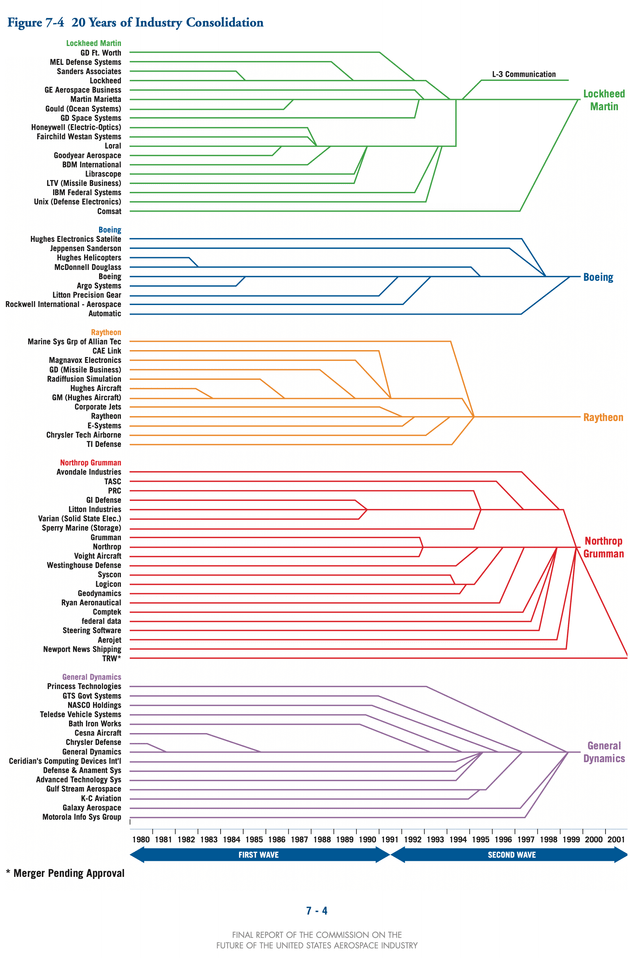
Over the past three decades, all traditional defense primes have aggressively pursued mergers and acquisitions as a major source of growth. Companies like RTX, Lockheed Martin, and Northrop Grumman – each bearing combined names formed through successive mergers – are large conglomerates made up of many different business lines acquired over decades. Conglomerates are able to add additional value to each acquired asset by integrating disparate systems together, and building inter-operability, ultimately making the whole system more valuable than the sum of its parts.
Several new entrants, most notably Anduril and UForce have pursued this M&A-focused conglomerate approach. Since its founding in 2017, Anduril has completed nine acquisitions that now underpin much of its core IP. For example, its Fury platform, which is now competing for the Air Force’s CCA contract, was originally developed by Blue Force Technologies and acquired in 2023, while its Dive-LD platform, which was selected for the Navy’s XL-AUV program, was developed by Dive and acquired in early 2022. A core element of Anduril’s acquisition strategy is integrating disparate hardware into its Lattice software platform, creating a unified, interoperable system. Anduril also centralizes go-to-market and business development functions, giving each platform far greater reach into the DoW than a standalone company could achieve on its own.4
UForce is a Ukrainian defense company which has taken a similar approach. During the Russia-Ukraine conflict, a wave of small Ukrainian defense companies emerged, each focused on developing specialized battlefield systems. While individually these companies lack the scale and resources to become multi-billion-dollar businesses or navigate complex international defense procurement processes, when merged into one company they can reach a much broader market. UForce is a strategic consolidation of nine specialized Ukrainian defense companies, whose portfolio of products include some of the most important battle-tested platforms in Ukraine. Its most well-known is the Magura unmanned surface vessel, which was responsible for sinking a significant portion of the Russian Black Sea fleet. Its other products include Nemesis strike drones, Liut unmanned ground vehicles, Sunray counter-UAS laser system, and Bucha fixed-wing UAS interceptor. Similar to Anduril, UForce integrates all its product lines into a centralized command and control (C2) software and autonomy layer. Since consolidating these product lines into one company, UForce has onboarded an American-Ukrainian CEO, moved its headquarters to the U.K., raised more than $50M from international investors (becoming Ukraine’s first defense tech unicorn), and struck deals with European NATO allies.
Tech Enabled Services
A significant amount of the defense budget goes to services providers – that is, businesses whose primary product is human labor which they bill by the hour. Over the past few years, a new generation of startups have emerged using AI to provide services much more efficiently while achieving high gross margins. This new crop of businesses is poised to disrupt a number of services industries, including legal, HR, and finance – and defense is no exception.
For example, consider cyber operations: both defensive and offensive DoW cyber operations are dominated by contractors. Services firms provide the government with everything from security operations analysts to incident response teams to vulnerability researchers to exploit developers. Already, startups are using AI to disrupt these services-heavy operations. Companies like TENEX provide AI-enabled security operations, detection, and response services, while companies like Autonomous Cyber use AI to automate vulnerability research and exploit development services.

Advanced code generation models are also enabling a new set of companies to disrupt traditional engineering services businesses. The DoW often hires engineering services firms to manage projects like codebase modernization, custom software development, system of record implementations and migrations, and more. However, as code generation models have improved, the need for large, legacy teams of software engineering service providers has decreased. Palantir, known for its engineering-services-oriented “forward deployed engineer” (FDE) model, has introduced an “AI FDE” offering, deploying AI systems to perform work traditionally done by human FDEs, and is now using these models to execute engineering services tasks such as data migration. Similarly, companies like Code Metal and Cognition5 are exploring using their automated code translation capabilities to work on government codebase modernization and optimization contracts. Projects which previously would have required armies of contracted software engineers now require just a few engineers armed with powerful coding models.

The power of AI to disrupt services extends beyond engineering and cybersecurity services. For example, Hedral develops tools that automate architectural engineering design, a traditionally human labor heavy industry, and, according to Obviant data, has won several contracts to provide automation-enabled architectural engineering services to the DoW for building design. One could envision a future where legal AI startups like Legora and Harvey provide the DoW with automated solutions that displace traditional law firms for low-value, routine legal work.
Roll Ups
In recent years, a number of startups have raised VC funding to “roll up” mature, cash flowing companies in fragmented industries and drive operational efficiencies using AI and automation, taking a new, tech-enabled spin on a traditional private equity investment strategy. The defense industry, particularly defense manufacturing, is no exception.
Much of the U.S. defense manufacturing sector is fragmented and composed of a number of small, family owned businesses, with predictable cash flows, many of which have aging owners looking to exit their businesses. Modernizing the playbook of private equity roll-ups like aerospace component manufacturer TransDigm,6 several startups are buying up various manufacturing facilities, particularly those focused on tier 1 and below component manufacturing, and outfitting them with systems like AI-native ERP, MES, MRP, supply chain management, procurement, and quoting tools, as well as with robotics capable of automating key parts of the manufacturing process.
Re:Build Manufacturing, which has raised more than $120M, has acquired a number of small engineering and manufacturing firms, including battery designers, precision component manufacturers, composite manufacturers, and more, leveraging expertise and economies of scale to streamline marketing, product commercialization, supply chain management, and manufacturing processes. Wilder Industries, which initially started out as a manufacturing robotics automation company, has since acquired several manufacturing and aerospace component companies across CNC machining, sheet metal fabrication, and UAV manufacturing, and is working to equip these acquired assets with more efficient manufacturing technology. Amca has raised more than $75M of VC funding to acquire legacy aerospace component manufacturers including a pressure switch company, an electromechanical avionics company, and a magnetics company, bringing modern manufacturing techniques and business practices to these legacy businesses. In March 2025, Jeff Bezos announced that he is launching a $100B fund to acquire manufacturing firms and transform them with AI.
Factory as the Product
Rather than selling individual products, acquiring legacy facilities, or retrofitting incumbents with new technologies, a number of startups are pursuing a “factory-as-product” model – building next-generation factories designed to produce custom goods for aerospace and defense customers using more efficient, lower-cost, and modern manufacturing processes. In particular, many “factory-as-product” businesses automate processes like quoting, tooling design, and tooling manufacturing, which can take up the majority of time needed to manufacture complex parts.
For example, Hadrian has built a large, software-defined CNC machine shop that uses automation to improve margins and reduce lead times. Its proprietary software streamlines CAM programming, quoting, and quality inspection, while integrated robotics handle material movement across the factory floor. Rangeview has built a factory that uses advanced investment casting techniques, centered on 3D-printed molds, to produce precision parts for aerospace and defense customers. Its software automatically designs and prints casting molds, while integrated robotics automate much of the physical casting process.

Atomic Industries uses AI and generative physics simulation and modeling to efficiently design and build optimized molds for injection molded parts crucial for automotive, aerospace, and defense industries, significantly reducing tooling costs (which can run $50K+ per mold) and lead times. It operates a vertically integrated “factory-as-product” business model where customers purchase injection molded parts directly from Atomic Industries.7 Layup Parts sells composite parts to aerospace and defense customers, leveraging techniques like automated quoting, generative tooling design, automated layering, and factory robotics to reduce lead time from several months to several days.
Contractor-Owned Contractor-Operated (COCO)
Several startups are exploring contractor-owned, contractor-operated (COCO) business models. Rather than selling a product directly to the DoW, COCO businesses maintain ownership of their products and operate the products on behalf of their customers. For example, consider an ISR8 drone use case: in a non-COCO model (also known as GOGO – government-owned, government-operated), the DoW would purchase an ISR drone, and U.S. military personnel would fly and operate that drone. In a COCO model, the vendor retains ownership of the drone and operates it on behalf of the military customer, delivering ISR data to the DoW rather than selling the drone itself.
This business model is attractive for several reasons. First, DoW does not need to spend the money to purchase and maintain an expensive platform. Second, DoW does not need to spend the time and resources to train their own personnel to operate potentially complicated technology. Third, it allows the DoW to have access to the most cutting edge technology, without going through complicated contracting processes every time technology is updated. Because the contractor owns the underlying technology platform, they can continuously update the platform (or even replace it entirely) with the latest technology and capabilities without needing the DoW customer to purchase the new technology system.
Several startups have already begun operating COCO services — Shield AI and Aerovironment were both selected for a Navy ISR drone COCO contract. Earlier stage startups, like Atropos, are also exploring this business model for aircraft (Atropos “is building the future of autonomous flight as a vertically integrated, design-build-test-and-operate service”).
Similar to COCO, some companies leverage a contractor-owned, government-operated “as-a-service” model. Vector Defense, for example, offers “modern-warfare-as-a-service” by integrating hardware and software to develop attritable, autonomous systems, and selling those systems “as-a-service” under operations and maintenance (O&M) services contracts.9 Instead of selling drones outright, it sells a subscription that provides continuous access to drone capabilities, replaces attrited systems, and keeps fleets updated with the latest technology. Beyond hardware, Vector delivers upgrades, training, and tactical integration, drawing on field insights from active conflict zones to refine TTPs and operational effectiveness.
“Americanization” Companies
Today, significant military technology innovation is happening outside of the U.S. on the battlefield in places like Ukraine and the Middle East. However, generally, outside of a handful of exceptions, the U.S. military does not purchase technology directly from foreign companies, unless that company has a U.S. subsidiary. Often, when the DoW is interested in some foreign capability, U.S. defense primes establish teaming agreements with foreign companies to bring that capability to the U.S. For instance, in 2015, Kongsberg and Raytheon announced a teaming arrangement to bring the Norwegian RGM-184A missile to the U.S.
Several companies have entered the market to procure battle-tested technology from live conflict zones abroad (most notably Ukraine and the Middle East) and adapt that technology to the U.S. military by helping shape doctrine, tactics, techniques, procedures, and training for these foreign-developed systems. For instance, Revenant Technologies, which is founded and operated by U.S. veterans, partners with select foreign technology firms with battle-tested systems, enables U.S.-based demonstrations, pilots, and training, for those systems, and manages U.S. sales, program integration, and on-shoring of manufacturing for those systems.
Holding Companies
Unlike most traditional VC-backed technology startups, several young national security startups have structured themselves as holding companies. A holding company is a parent entity that owns controlling stakes in other businesses (referred to as subsidiaries), typically without managing their day-to-day operations. For example, Alphabet is a holding company that owns multiple subsidiaries including Google, Waymo, Google Ventures, Nest, and Google X.
Holding companies are common in the defense industry. For example, L3 Communications Holdings, which later merged with Harris to become L3Harris, the sixth largest U.S. defense contractor, was initially established as a holding company to acquire and hold certain business units from Lockheed Martin in the 1990s. L3 Communications managed a wide range of businesses across training and simulation, command and control, communications, intelligence, surveillance and reconnaissance (C3ISR) systems, ocean products, navigation products, and more.
This model offers several advantages: legal separation between subsidiaries limits risk while the parent company centralizes functions like legal, compliance, IT, and facilities to reduce duplication and create leverage, especially valuable in the complex regulatory environment of defense contracting. It also simplifies government engagement by providing a single counterparty instead of many small vendors. Scale further improves access to capital and purchasing power, allowing the parent to raise debt and equity more efficiently, secure better vendor terms, and achieve manufacturing economies of scale. Finally, consolidated finances provide flexibility, enabling profits in one business to offset losses in another and allowing the parent to redeploy capital from mature units into newer efforts without relying on external funding.
Holding companies can provide scale to more market-limited business. Many defense products are crucial for the warfighter, but have limited market sizes that make them unattractive for VC investment. Ultimately, VC investors are looking to invest in companies that can have multi-billion dollar exits (either via acquisitions or going public) within a 10-12 year time frame – a model that most defense companies do not fit.
In response, a new class of startup holding companies has emerged, assembling portfolios of smaller, mission-critical businesses whose combined scale can meet venture expectations. A leading example of this new wave of defense holding companies is Valinor. Valinor has raised over $85M and is developing a suite of defense products including a mobile modular medical system, modular charging nodes for unmanned systems, and an augmented-reality platform. While each subsidiary maintains an independent engineering team, Valinor centralizes functions like defense business development, go-to-market, compliance, security, and marketing, allowing its portfolio companies to share infrastructure and scale more efficiently.10
Conclusion
In order to successfully deliver the technology needed for the U.S. to remain competitive in the face of peer adversary competition, startups must be creative in how they structure their businesses to deliver value to customers. Like the legacy defense primes before them, national security startups cannot rely on traditional VC-backed business models like SaaS to succeed with national security customers. Instead, they must adapt to the realities of a regulated, single-buyer market, experimenting with models that better align with how the government and defense primes buy, fund, and deploy capability. The companies that win will not just build superior technology; they will design business structures that navigate procurement constraints, accelerate adoption, and ultimately translate innovation into fielded capability at scale.
For more on Congressional appropriations decision making, see our Mission Matters podcast episode with former House Appropriations Committee for Defense staff director Johnnie Kaberle.
For a good example of Congress funding programs against DoW’s stated priorities, see the fight over the Littoral Combat Ship (LCS) program.
The Defense Travel System (DTS) is a piece of custom, arcane travel management software written by Northrop Grumman (a company that is not known for its software application engineering talent). The system is widely hated throughout the DoW and truly showcases the extremes DoW will go to to avoid procuring off the shelf software. Users largely agree that almost any other off the shelf travel system (of which there are many readily available on the commercial market) would be better than DTS.
For more analysis on Anduril’s M&A strategy, see this excellent piece by Packy McCormick: “Anduril: Acquiring Prime.”
For more on Cognition’s work with the government, see this ChinaTalk podcast episode with co-founder Russell Kaplan.
This approach of rolling up tier 1 and below aerospace and defense component suppliers and manufacturers is not new – firms like TransDigm infamously pioneered this business model. Founded in 1993 when four industrial aerospace companies were combined by a private equity firm in a leveraged buyout, TransDigm focuses on acquiring aerospace component manufacturers, and has acquired more than 60 businesses over its history. Many accuse TransDigm of price gouging by purchasing 1 of 1 component suppliers and driving up prices, driving remarkably high margins (during an investigation, the DoW uncovered that TransDigm made 9400% margins on a simple metal pin). This new generation of VC-backed roll ups like Amca and Wilder can bring new efficiencies to the industry, rather than merely increasing prices without adding additional value.
For more on Atomic Industries, see this business breakdown by Michael Palank.
ISR = intelligence, surveillance, reconnaissance
Note the O&M budget is much larger than the DoW’s R&D and procurement budgets.
